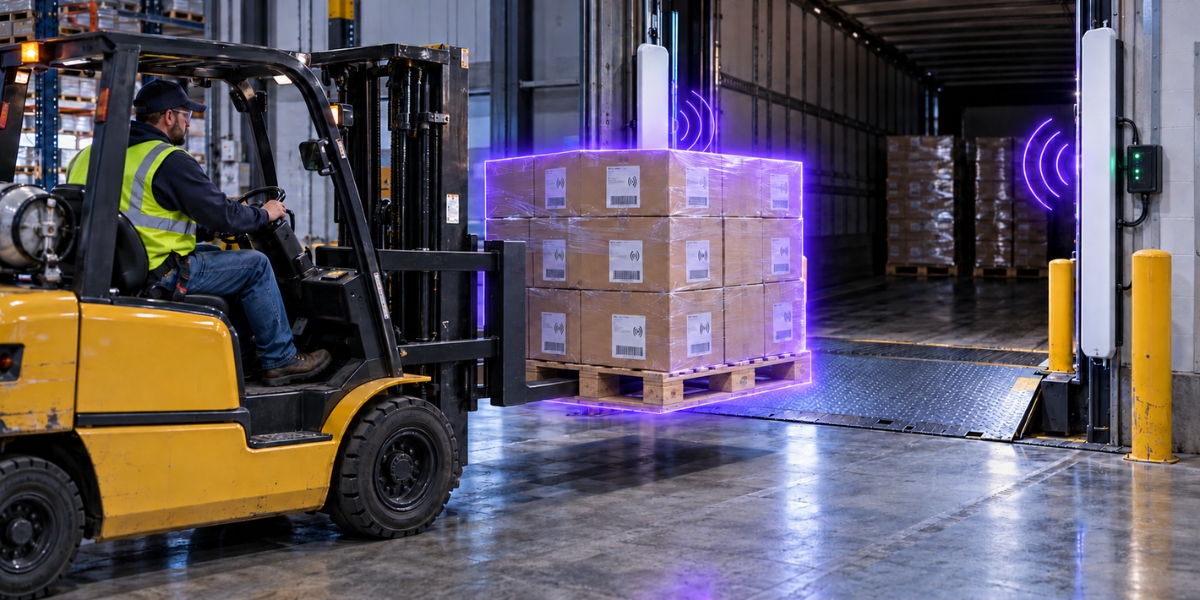
RFID Inventory Management: How Warehouses and Retail Get Real Time Counts
RFID inventory management cuts cycle counts from hours to minutes. See how warehouses and stores use it, what hardware to buy, and factors to know.

My Cart
—
Incl. VAT
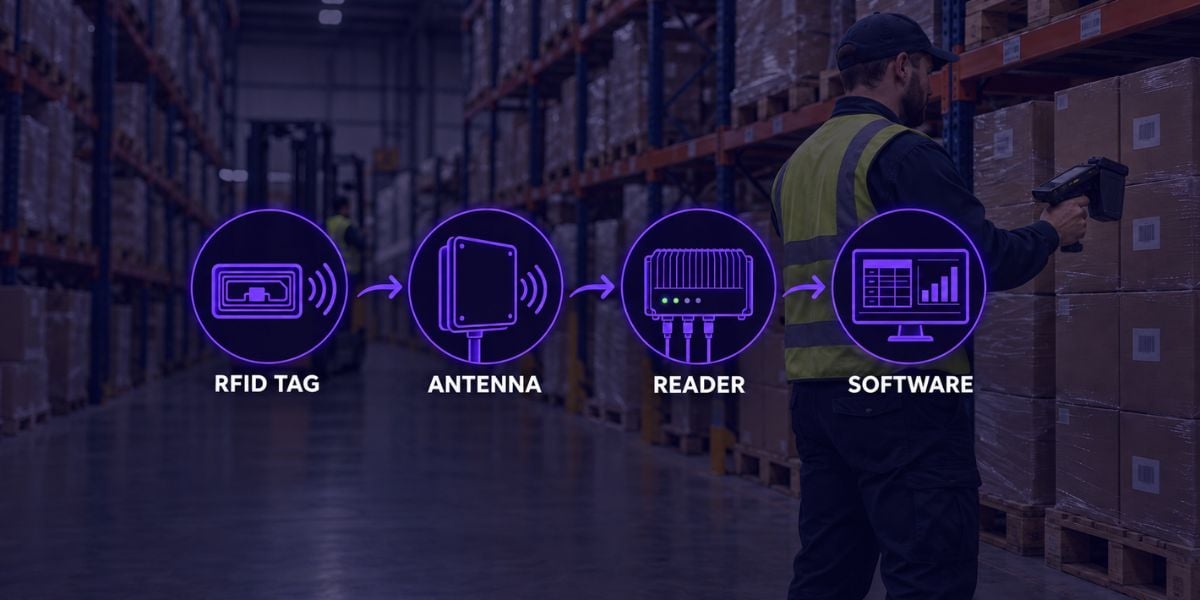
RFID tags work by pairing a microchip with an antenna that answers a reader's radio waves, with no line of sight needed: passive tags take their power from the reader's signal and reflect their stored ID back, while active tags use a battery to send their own signal. Which tag you need comes down to three things, the frequency, how far away you need to read it, and the surface the tag goes on.
The reader then passes that ID to your inventory or warehouse software. This guide explains how RFID tags work from the inside out, the chip, antenna, substrate and memory, then gives you a chooser table that matches a tag to the item you need to track.
RFID tags work by turning a reader's radio signal into just enough power to answer it with a stored ID number. For a passive UHF tag, the kind used most in warehouses and retail, that exchange takes a fraction of a second and happens in four steps.
Because the tag answers by reflecting the reader's own signal, it needs no battery and no line of sight. Impinj puts the read range for passive RAIN tags at up to about 30 feet, and a single reader can identify more than 1,000 tagged items per second.
That is the tag's side of the conversation. For the readers, antennas and software around it, see our guide to what RFID is and how it works.
Inside every RFID tag are three parts, a chip, an antenna and a substrate, and together they form what the industry calls an inlay. Everything else you see on a tag, the label paper, the plastic case, the adhesive, is packaging around that inlay.
| Part | What it does | Why it matters when you buy |
|---|---|---|
| Chip (IC) | Stores the tag's ID numbers and runs the radio protocol | Sets how much memory the tag has and which features it supports, like password locking |
| Antenna | A flat metal pattern that catches the reader's energy and carries the reply | Its size and shape drive read range, which is why a larger inlay usually reads farther than a small one |
| Substrate | The thin film the antenna is printed, etched or stamped onto, typically paper or PET | Sets how flexible the inlay is and how it holds up to heat, moisture and bending |
Converters take the inlay and turn it into a product. A dry inlay has no adhesive and gets built into your own packaging or product. A wet inlay has an adhesive backing. A label adds a printable face, and a hard tag seals the inlay inside plastic or epoxy so it survives impacts, washing and outdoor use.
An RFID tag stores a short ID number, and on most UHF tags that data sits in four memory banks defined by the Gen2 standard. The tag works like a license plate: it identifies the item, and your software holds everything else about it, the price, the location history, the owner.
| Memory bank | What it holds | Can you change it? |
|---|---|---|
| Reserved | A 32-bit kill password and a 32-bit access password | Yes, and it can then be locked |
| EPC | The Electronic Product Code, the item's ID number | Yes, it is written when the tag is encoded |
| TID | The chip maker and chip model, locked at the factory | No |
| User | Optional extra data, and many low cost tags have none | Yes, where the chip has it |
The amounts are small. Impinj's current chips show the range: the M830 has 128 bits of EPC memory, and the M850 has 96 bits of EPC memory plus 32 bits of user memory. That is enough for a serialized ID and a few flags.
The EPC number itself usually follows GS1 rules. A company licenses a GS1 Company Prefix and uses it to build EPCs, so the same tag can be read and understood by a retailer, a distributor or a 3PL down the line.
An RFID tag gets its power from one of three places: the reader's signal, a small battery that runs only the chip, or a battery that runs the whole radio. That choice shapes the tag's range, size, lifespan and price more than any other.
| Tag type | Power source | How it answers | Typical uses |
|---|---|---|---|
| Passive | The reader's signal | Reflects the signal back (backscatter) | Cartons, pallets, retail items, IT assets, returnable containers |
| Battery assisted passive | A battery runs the chip, the reader's signal still carries the reply | Reflects the signal back | Sensor tags and assets that need a more reliable read than a passive tag gives |
| Active | A battery runs the chip and its own transmitter | Sends its own signal | Vehicles, yard equipment and large assets tracked over long distances |
Passive tags have no battery to wear out, and GS1 US notes they can last up to 20 years. Active tags cost more and need battery replacements on a schedule. Our active vs passive RFID comparison sets cost, read range and lifespan side by side.
Frequency changes how a tag connects to the reader. LF and HF tags couple with the reader's magnetic field at close range, while UHF tags catch a radio wave and reflect it back, which is what gives UHF its longer range.
| Band | Frequency | How the tag connects | Typical read distance | Common uses |
|---|---|---|---|---|
| LF | 125 and 134.2 kHz | Magnetic coupling, near field | About 3 inches with handheld readers | Animal ID, access control |
| HF and NFC | 13.56 MHz | Magnetic coupling, near field | About 2 to 3 inches with handheld readers | Access cards, libraries, NFC |
| UHF (RAIN) | 865 to 928 MHz, by region | Radio backscatter, far field | Up to about 30 feet | Inventory, supply chain, retail, asset tracking |
The LF and HF frequencies and handheld distances come from TSL's RFID comparison, and the UHF range comes from Impinj. Fixed readers with larger antennas extend all three.
UHF is regulated country by country. GS1's regulation tracker lists 902 to 928 MHz for the US and Canada and 865.6 to 867.6 MHz for most EU countries. Our RFID frequency guide covers each band in depth, including how to choose one for your application.
RFID tags struggle on metal and liquids because both change how the tag's antenna behaves. Metal reflects the signal and detunes an antenna placed flat against it, and water absorbs UHF energy before it reaches the chip.
The effect depends on the band. TSL notes that UHF tags can be detuned by metal, liquids and even people unless the tag is engineered for it, while LF tags are largely unaffected by nearby water or metal. That is why animal ID runs on LF and why a standard UHF carton label fails on a steel cage.
For UHF, the fix is in the tag's construction. Three designs cover most cases, and Zebra's guide to challenging RFID applications describes all three:
The RFID tag type you need depends on two things you already know: what the tag is going on and how far away you need to read it. Use the table below as a starting point, then test the shortlist on your own items.
| What you are tagging | Surface | Read range you need | Tag to start with | Band |
|---|---|---|---|---|
| Cartons, cases and pallets | Cardboard | Several feet, at dock doors and with handhelds | Printable UHF label | UHF |
| Apparel and retail items | Fabric, paper hang tags | A few feet, for handheld cycle counts | UHF inlay in a hang tag or label | UHF |
| Plastic totes and returnable containers | Plastic | Several feet, at dock doors | Rugged UHF hard tag | UHF |
| Tools, IT equipment and metal racks | Metal | A few feet to tens of feet | UHF on-metal tag | UHF |
| Bottles, drums and IV bags | Liquid | Close range to a few feet | Flag label or spacer tag, or HF for close reads | UHF or HF |
| Patients, guests and staff | Wrist | Inches to several feet | RFID wristband | HF or UHF |
| Access badges | Card held to a reader | Inches, at a door reader | HF or LF card | HF or LF |
| Livestock and animals | Tissue | Inches | LF ear tag | LF |
Two patterns stand out. Anything tracked in bulk through a building runs on UHF, and the only question is how rugged the tag must be. Anything read one at a time, close to the reader, can use HF or LF, where metal and liquid matter far less.
Levata stocks RFID tags across these constructions, including on-metal and hard tags from the major tag makers, so you can shortlist two or three options for each item type and test them side by side.
The right RFID form factor is the lowest cost one that survives your environment and reads reliably on your item. The inlay inside may be identical across all four, and the packaging is what changes.
| Form factor | What it is | Best for | Tradeoff |
|---|---|---|---|
| Inlay | Chip and antenna on a substrate, dry or with adhesive | Building tags into your own labels, packaging or products | No face stock or protection |
| Label | An inlay inside printable label stock | Cartons, pallets and shelf items, printed and encoded in one pass | Wears in harsh conditions, and standard labels detune on metal |
| Hard tag | An inlay sealed in a plastic or epoxy case, often screw or rivet mounted | Metal assets, returnable containers, outdoor equipment | Costs more per tag and cannot be printed on demand like a label |
| Wristband | An inlay inside a band | Patients, guests, event and venue access | One person per band |
A hospital is a good example of mixing them. Patient wristbands, labels on specimen and supply cartons, and on-metal hard tags on infusion pumps and carts can all run on one UHF system, with each form factor matched to what it is stuck to.
Data gets onto an RFID tag in two stages: the chip maker locks the TID at the factory, and you or your supplier write the EPC when the tag is encoded. Encoding happens in an RFID printer that writes the chip and prints the label face in one pass, or with a reader for tags that are already applied.
Premium Guard, an aftermarket auto parts maker, shows how this works at scale. With Levata, the company relabeled more than 600,000 boxes using powered mobile carts with RFID label printers on the warehouse floor. Shipments are then checked by an RFID tunnel and RFID dock doors, and ten of its vendors began applying RFID labels before their goods arrive.
That last step matters. When suppliers encode tags at the source, every box shows up ready to read, and the receiving team skips the labeling step entirely.
Before you buy RFID tags in volume, test a small batch on your actual items, with your actual readers, in the place they will be read. Datasheet ranges are measured in good conditions, and a tag that reads well on a test bench can fall short on a full pallet of bottled product.
RFID is also not always the right buy. If items are scanned one at a time at a counter and nobody counts in bulk, a barcode label costs less and does the job. RFID earns its cost when you need to read many items at once, through packaging, without lining each one up.
Yes, as long as its memory has not been permanently locked. The EPC and user memory on most UHF tags can be rewritten, while the TID stays fixed from the factory. Rewritable tags are common on returnable totes and containers, where one tag follows the asset for years.
Yes. Passive UHF tags do not need line of sight, so a reader can pick up tags inside cardboard cases or under shrink wrap. Metal and liquid between the tag and the reader are the exceptions, which is why tag placement on the item matters.
Often it will, but check before you ship. The reader is what must follow local rules, 902 to 928 MHz in the US and Canada and 865.6 to 867.6 MHz across most of the EU. Many tags are tuned to read in both bands, and the tag's datasheet will say whether it is rated for global use.
Yes. Gen2 tags support a kill command, protected by the 32-bit kill password in the Reserved memory bank. A killed tag no longer answers any reader. If you only want to stop changes to the data, locking the memory with the access password is the reversible option.
An RFID tag is a chip, an antenna and a substrate, packaged for the item it goes on. Pick the band by how far you need to read, pick the construction by the surface, and test before you buy in volume.
Speak to an Expert. If you are not sure which tag will read reliably on your metal assets, totes or packaged goods, a Levata RFID specialist can help you build a shortlist to test. Speak to an Expert
RFID inventory management cuts cycle counts from hours to minutes. See how warehouses and stores use it, what hardware to buy, and factors to know.
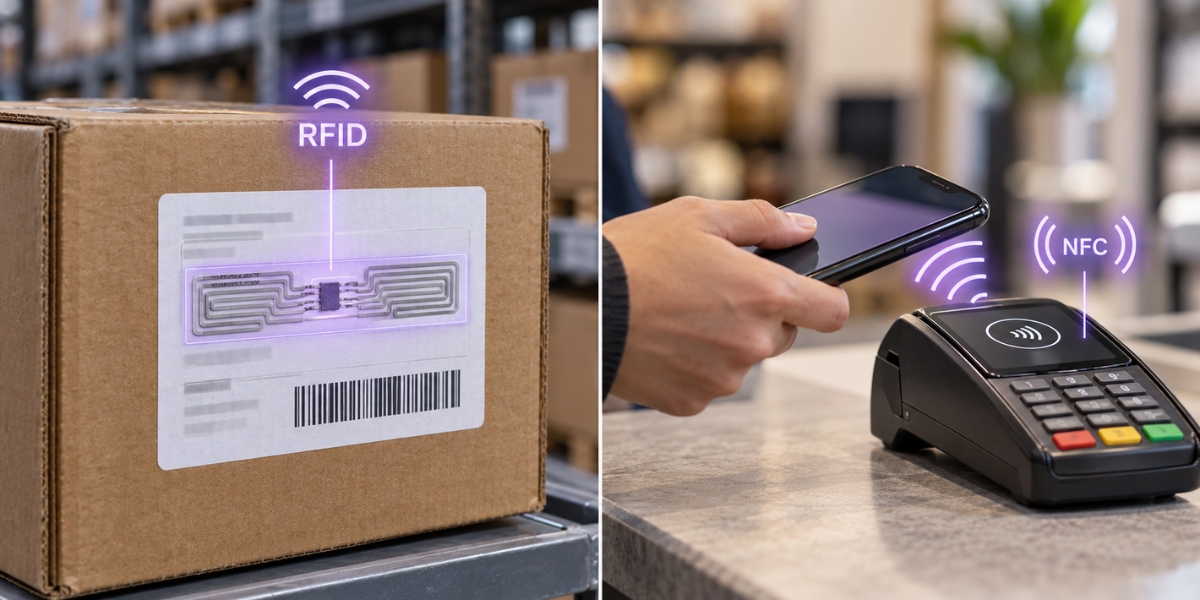
See how RFID and NFC differ on range, standards, and use, plus which one fits inventory tracking versus payments and access.
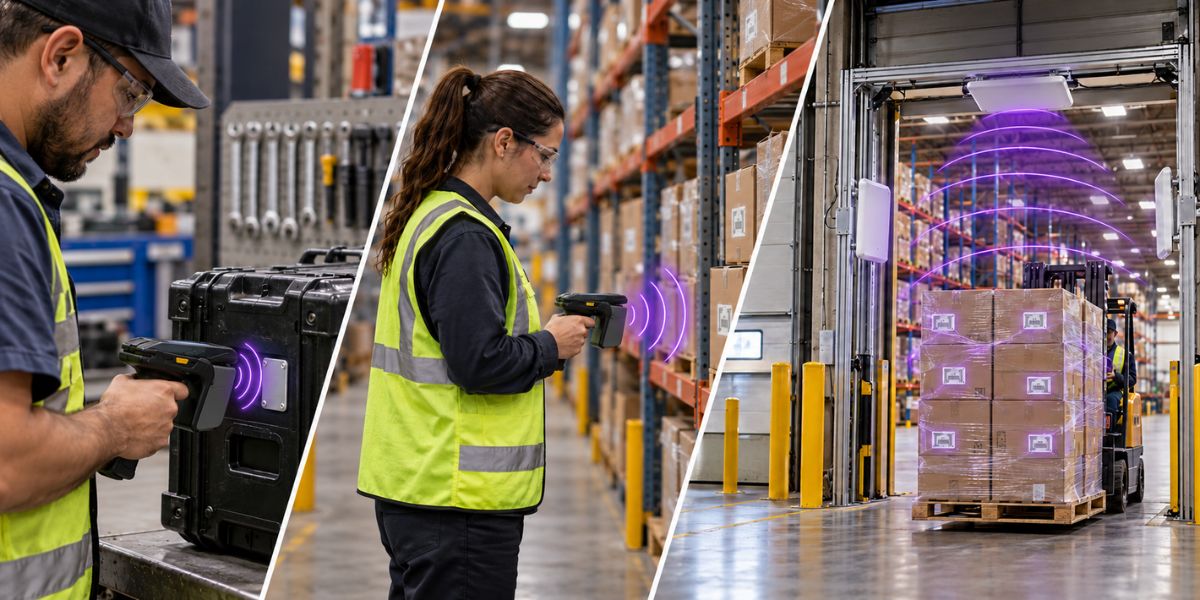
Compare LF, HF, and UHF RFID on range, standards, regulation, and best use, with a reference chart built to save and cite.
Welcome, ID Card Group customers!
On September 24th, IDCardGroup.com transitioned to Levata.com. You still have access to the ID solutions you rely on, along with a broader selection of data capture and technology solutions.
What you can expect:
Questions? Call 1-833-353-8282.
Thank you for choosing Levata.
Welcome, IT Planet customers!
On September 24th, ITPlanet.com transitioned to Levata.com. You still have access to the products you rely on, along with a broader selection of data capture and technology solutions.
What you can expect:
Questions? Call 1-833-353-8282.
Thank you for choosing Levata.
Welcome, Barcode Planet customers!
On September 24th, BarcodePlanet.com transitioned to Levata.com. You still have access to the products you rely on, along with a broader selection of data capture and technology solutions.
What you can expect:
Questions? Call 1-833-353-8282.
Thank you for choosing Levata.