How Do RFID Tags Work, and Which Type Do You Need?
How do RFID tags work? See how the chip, antenna and power source work together, then match a tag to your surface and read range.

My Cart
—
Incl. VAT
RFID inventory management counts stock by radio, so one handheld reader picks up hundreds of tagged items per second without line of sight, while a barcode count needs a separate scan for every item. In a study by the Auburn University RFID Lab and GS1 US, store inventory accuracy rose from 63% with barcodes to 95% with RFID, and cycle count time fell by 96%.
For a warehouse, that means counts that fit inside a shift and shipments checked at the dock door. For a store, it means knowing what is on the floor before a customer asks for it. This guide covers how the system works, where it pays, the hardware to buy, and the cases where barcodes are still the better call.
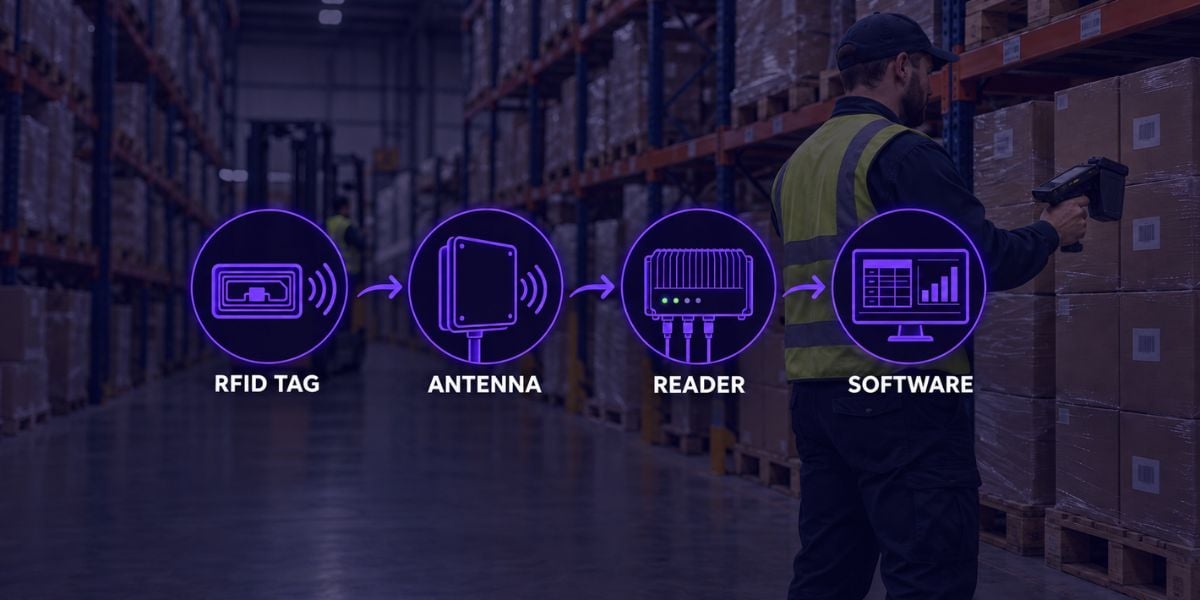
RFID inventory management works in three parts: a passive tag on each item or case, a reader with antennas that powers and reads those tags by radio, and software that turns the reads into stock counts. Each tag holds a unique code, so the system knows it counted 48 different units of one SKU and did not count the same unit twice.
Most inventory systems use passive UHF tags built to the GS1 EPC Gen2 standard, which has no battery and runs on the energy sent by the reader. The reader collects every tag in range, filters out duplicates, and passes the list to your warehouse management, ERP or point of sale system.
The tag does not need to face the reader. It can sit inside a carton, under a garment fold or on the back of a shelf. That is the single difference that makes a full count practical on a normal workday. If you want the background on frequencies and tag types first, our earlier article on how RFID tags work covers the basics.
RFID vs barcode inventory counts comes down to speed and accuracy against cost per item. Barcodes are cheap to print and every system reads them, but each item needs its own scan with a clear line of sight. RFID reads many items at once through packaging, which is why counts drop from hours to minutes.
| Barcode counts | RFID counts | |
|---|---|---|
| How items are read | One at a time, scanner must see the label | Many at once, no line of sight needed |
| Read speed | One scan per item | Thousands per second |
| Inventory accuracy in the Auburn and GS1 US study | 63% | 95% |
| Cycle count time | Baseline | 96% shorter |
| Unit identity | Usually SKU level | Unique serial per tag |
| Cost per label | Lowest | Higher, adds an RFID inlay |
| Works on metal and liquids | Yes | Needs on-metal tags or tested placement |
An Auburn University RFID Lab and GS1 US study found that RFID cut retail out-of-stocks by up to 50%. Inventory errors cost real money at scale. IHL Group puts the global cost of out-of-stocks and overstocks at $1.73 trillion a year.
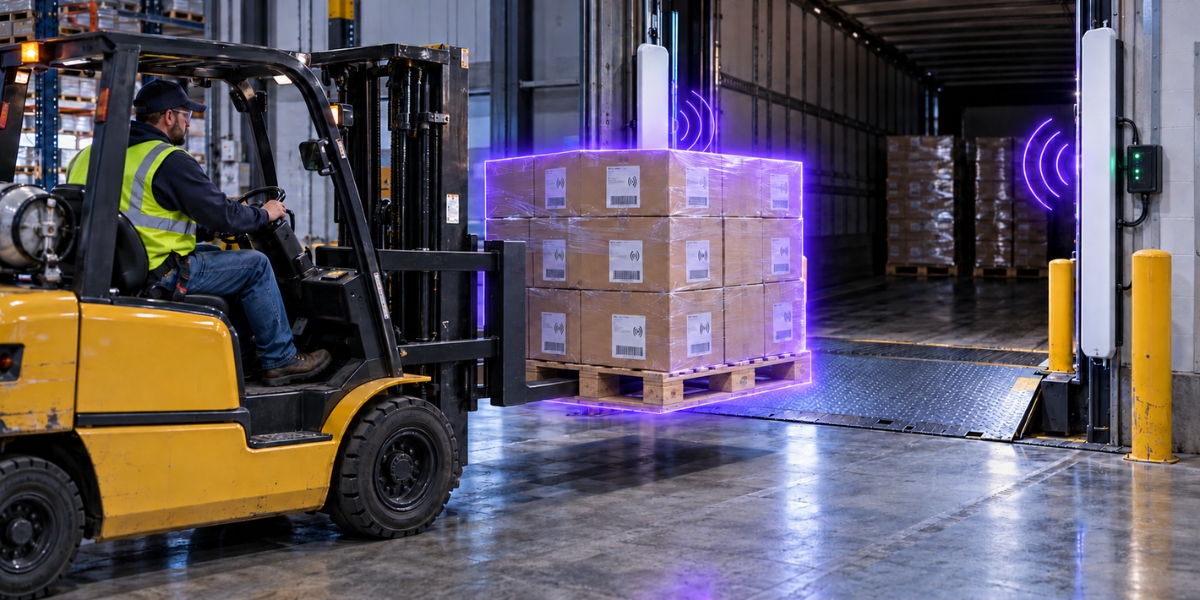
Warehouses use RFID inventory management at three points: receiving, cycle counts in the racks, and shipping. Fixed readers at doors and conveyors record every tagged pallet and case that passes, and handheld readers count stored stock without pulling it off the shelf.
Shipping is where the money shows up first. An RFID dock door confirms the right cartons are going onto the right truck before the trailer leaves, which stops mis-shipments before they turn into chargebacks.
Premium Guard, an aftermarket auto parts manufacturer, is a good example. Mis-shipments to its largest retail customer were causing chargebacks and return freight costs. Working with Levata, it relabeled more than 600,000 boxes, added an RFID tunnel tied to its ERP to verify pallet contents, put readers on its dock doors, and moved pallet cycle counts to mobile RFID readers. Ten of its vendors now ship with RFID labels already applied, so new stock arrives ready to count.
Retail stores use RFID inventory management to count the whole store often enough to catch missing stock while it still matters. A store associate walks the aisles with a handheld reader, and the count that once closed the store for a night takes minutes.
Brazilian apparel retailer Piticas saw this directly. After moving to RFID with handheld readers, its stores cut inventory counts from five hours to six minutes.
Faster counts make shrink visible. U.S. retailers reported shrink of 1.6% of sales, or $112.1 billion, in 2022, according to the National Retail Federation. A weekly RFID count shows which SKUs go missing and where, so loss prevention can act on a pattern instead of a year end surprise. The same counts keep online stock accurate, so buy online, pick up in store orders stop failing at the shelf.
An RFID inventory system needs four types of hardware: tags, a way to print and encode them, readers, and for fixed read points, antennas. The right mix depends on whether you count by walking the floor or by watching the doors. The table below shows just a few models Levata stocks for each job, with specs from the manufacturer.
| Job | Hardware | Levata models | Key spec |
|---|---|---|---|
| Cycle counts on the sales or warehouse floor | Handheld RFID reader | Zebra RFD40 | 1,300+ tags per second, about 20 ft read range |
| Counts in high racks or rough conditions | Rugged handheld RFID reader | Zebra RFD90 | Up to 75 ft with the long range model, IP65 and IP67 sealed |
| Receiving doors and conveyors | Fixed RFID reader | Zebra FX7500 | 1,200+ tags per second, 2 or 4 antenna ports, PoE powered |
| Dock doors from one reader | Fixed RFID reader | SLS D-Series | 2 antenna ports, bulk tag reading |
| Locating items in a zone | Overhead RFID reader | Zebra ATR7000 | Location typically within 2 ft |
| Printing and encoding labels | RFID label printer | Zebra ZT411 RFID | Encodes Gen2 and ISO/IEC 18000-63 tags, on-metal option |
| Tagging items and cases | RFID labels and tags | RFID labels and RFID tags | Passive UHF, matched to the surface |
Fixed readers need external antennas and cabling sized to each doorway, so plan those during the site survey. Browse the full range of RFID readers, or start from the RFID hardware and supplies category to see printers and tags alongside them.
Handheld or fixed RFID readers for inventory counts depends on one question: do you need to count what is on the shelf, or know the moment stock moves? Handheld readers answer the first. Fixed readers answer the second.
| Your situation | Start with | Why |
|---|---|---|
| You count weekly or monthly and stock moves through a few doors | Handheld readers | No installation, lowest upfront cost, one device covers the site |
| You need proof of what left on each truck | Fixed reader at the dock door | Every pass is recorded without anyone scanning |
| Receiving volume is high and runs on conveyors | Fixed reader at the conveyor or tunnel | Reads every case at line speed |
| You need to find specific items in a large area | Overhead reader | Reports location as well as presence |
Most sites end up with both. A distribution center might run fixed RFID readers at shipping and receiving and give each shift a handheld for cycle counts. If your budget covers only one first step, handhelds prove the value fastest, because they work the day they arrive.
RFID inventory management falls short on metal, liquids, low value items and messy processes. Each one has a fix, but each one adds cost or planning, and buyers should know that before purchase.
Metal reflects UHF signals and liquids absorb them, so cans, tools and bottled goods often read poorly with standard labels. On-metal tags and printers that encode them, such as the ZT411 on-metal option, solve most of this, at a higher cost per tag. Test tags on your real products before you order thousands.
| Limit | Why it happens | How to fix it |
|---|---|---|
| Metal | Reflects the radio signal | Use on-metal tags |
| Liquids | Absorb the radio signal | Test tag placement on real items first |
| Stray reads | Tags read from the next aisle or dock door | Tune antenna placement and reader power |
| Untagged stock | Items received without a tag | Tag at source or at receiving |
Strong readers can also pick up tags from the next aisle or the next dock door. Antenna placement and reader power settings control this, which is why fixed installations need a site survey. Finally, if your items are low value, your counts are small, or your suppliers will never tag at source, barcode labels and barcode scanners may still be the better choice. RFID makes a good process faster. It does not fix a process where stock is received without being recorded.
Roll out RFID inventory management in stages, starting with one zone or product category and a measured baseline. A phased rollout keeps the cost of mistakes small and gives you numbers to justify the next phase.
Tagging at the source is where the long term savings sit. Once suppliers apply labels before shipping, as Premium Guard's vendors now do, your team stops spending labor on tagging and only counts. For larger programs that span many sites, Levata's smart supply chain services cover design, deployment and support.
Most RFID users count far more often than they did with barcodes, because a count no longer takes a full shift. Weekly is common in stores and in fast moving warehouse zones. Slow moving or high value zones can be counted daily if needed, since the labor per count is small.
Usually not. Most current WMS, ERP and point of sale systems can accept RFID data, either directly or through middleware that filters duplicate reads first. Handheld readers also run counting apps on the paired mobile computer, which can export to the system you already use.
Some can. Hard tags on returnable totes, pallets and fixed assets are built to last for years and move with the item. Paper RFID labels on products and cartons are single use and leave with the shipment.
Inventory tracking almost always uses passive UHF RFID. The GS1 Gen2 standard covers 860 to 930 MHz, with the exact band set by each country's radio rules. Make sure readers and tags are ordered for the region where they will operate.
RFID inventory management turns cycle counts into a short routine task and makes stock visible at every door. The right setup depends on your products, your building and how often stock moves.
Levata's RFID team can review your site, test tags on your products and recommend the readers and printers that fit. Speak to an Expert
How do RFID tags work? See how the chip, antenna and power source work together, then match a tag to your surface and read range.
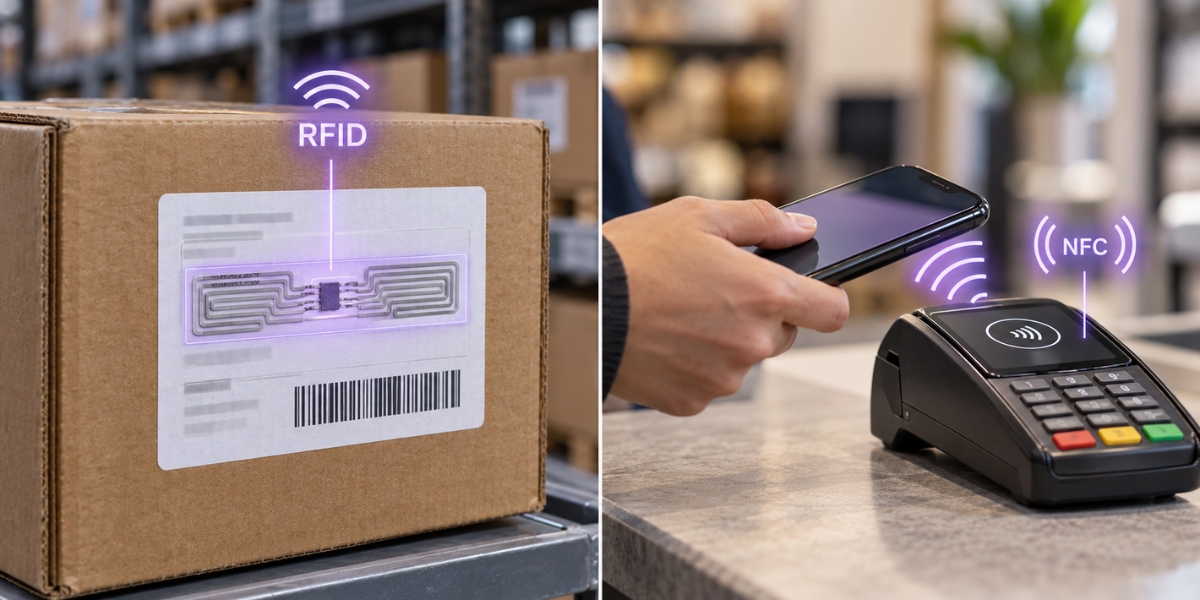
See how RFID and NFC differ on range, standards, and use, plus which one fits inventory tracking versus payments and access.
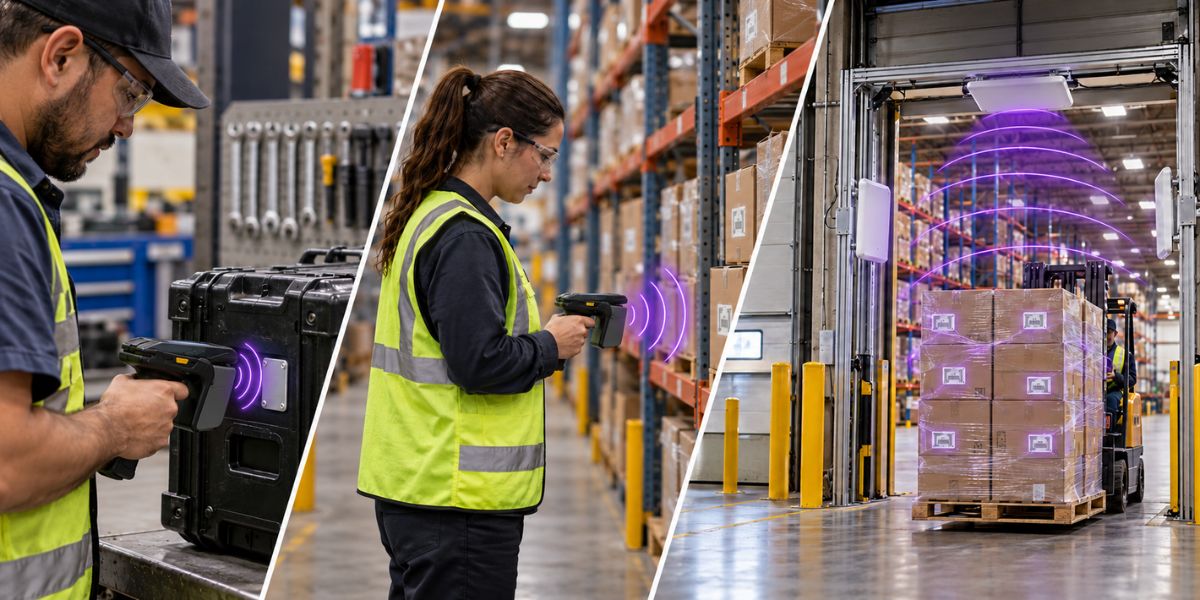
Compare LF, HF, and UHF RFID on range, standards, regulation, and best use, with a reference chart built to save and cite.
Welcome, ID Card Group customers!
On September 24th, IDCardGroup.com transitioned to Levata.com. You still have access to the ID solutions you rely on, along with a broader selection of data capture and technology solutions.
What you can expect:
Questions? Call 1-833-353-8282.
Thank you for choosing Levata.
Welcome, IT Planet customers!
On September 24th, ITPlanet.com transitioned to Levata.com. You still have access to the products you rely on, along with a broader selection of data capture and technology solutions.
What you can expect:
Questions? Call 1-833-353-8282.
Thank you for choosing Levata.
Welcome, Barcode Planet customers!
On September 24th, BarcodePlanet.com transitioned to Levata.com. You still have access to the products you rely on, along with a broader selection of data capture and technology solutions.
What you can expect:
Questions? Call 1-833-353-8282.
Thank you for choosing Levata.