
What Is RFID and How Does It Work? A Plain English Guide
What Is RFID and How Does It Work? A Plain English Guide

My Cart
—
Incl. VAT
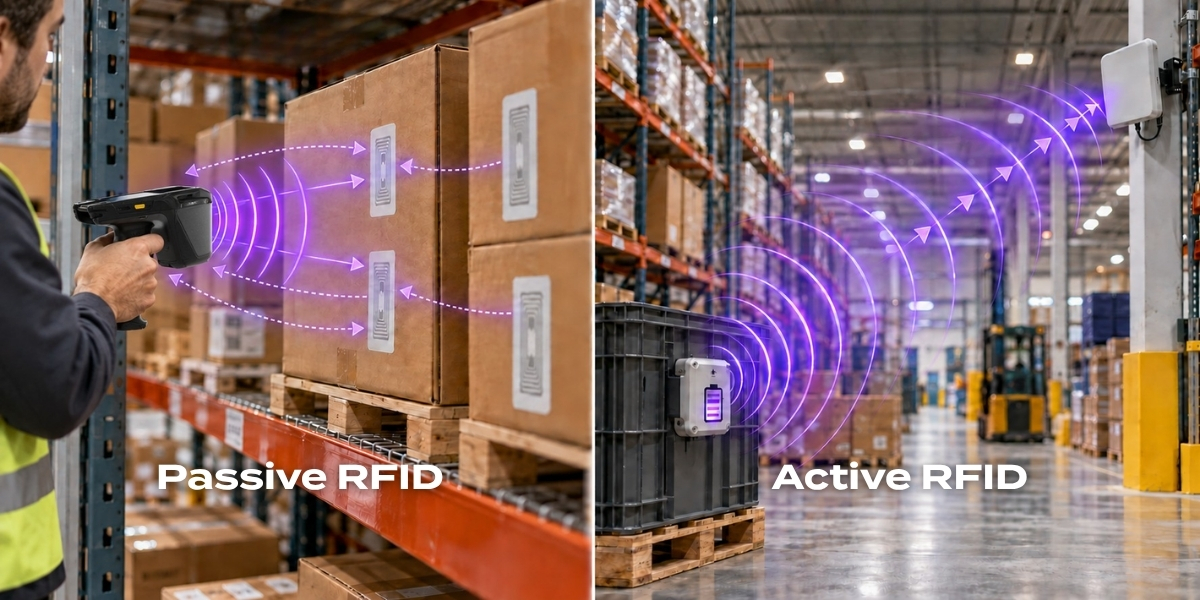
Passive RFID tags have no battery, cost cents to a couple dollars each, and read up to about 30 feet. Active RFID tags carry their own battery, cost $15 or more each, and read 100 to 300 feet or farther, which is why they only earn their higher cost when a job needs continuous, long range tracking.
| Passive RFID | Active RFID | |
|---|---|---|
| Power source | None, powered by the reader | Internal battery |
| Typical tag cost | About $0.05 to $2 per tag | About $15 to $100 or more per tag |
| Typical read range | Up to about 30 feet | 100 to 300+ feet |
| Tag lifespan | 10 to 20+ years, no battery to replace | 2 to 5 years typical battery life |
| Common frequency | LF, HF, or UHF (860 to 960 MHz) | 433 MHz or 900 MHz/2.4 GHz |
| Best fit | Inventory counts, checkpoints, supply chain | Real-time location, large yards, high-value assets |
The actual difference between active and passive RFID comes down to power. A passive tag has no battery and only responds when a reader's signal powers it up. An active tag carries its own battery and can broadcast on its own schedule, whether or not a reader is nearby.
That single difference drives almost everything else in this comparison. The FDA describes passive tags as powered entirely by the reader's signal and active tags as carrying their own power source, and that distinction is what shapes tag cost, read range, and lifespan across the rest of this guide.
Passive RFID tags cost far less per tag than active ones, and that gap only grows as a deployment scales. A basic passive label runs about $0.05 to $2 depending on the form factor, while an active tag with a battery and enclosure runs $15 to $100 or more.
That per-tag gap matters most when a business is tagging thousands of items. Tagging 10,000 pallets with passive labels costs a few hundred to a few thousand dollars in tags alone. Tagging that same volume with active tags would run into six figures, which is why active RFID rarely gets used at item level. Active systems also carry an ongoing cost passive systems don't: batteries typically need replacing every 2 to 5 years, adding a few dollars per tag per cycle on top of the original purchase.
Read range is where active RFID pulls ahead by a wide margin. Passive UHF tags read up to about 30 feet under good conditions, while active tags typically reach 100 to 300 feet or more.
Impinj puts typical passive UHF, often called RAIN RFID, at up to 10 meters or about 30 feet. Active tags close that gap by broadcasting their own signal instead of waiting for a reader to power them, which is what lets them reach well beyond 100 feet. Actual range for either type depends on the reader's power, the antenna, and what's nearby, metal and liquid both shorten passive range in particular.
Passive tags generally outlast active tags by a wide margin because they have no battery to wear out. A passive tag can last 10 to 20 years or more, limited mainly by physical wear on the label itself, while an active tag's battery typically lasts 2 to 5 years before it needs replacing.
Link Labs notes active RFID tags are commonly rated for a battery life of roughly three to five years, with some models lasting up to ten depending on how often they broadcast. A tag set to beacon every few seconds burns through its battery faster than one that only responds when a reader asks. This lifespan gap is part of why passive tags dominate high-volume, low-touch applications, there's no battery replacement cycle to plan around.
Passive RFID is the right call when you're tracking a lot of items and cost per tag matters more than maximum range. It fits most warehouse, retail, and supply chain applications, where items pass through a fixed checkpoint like a dock door or a portal and the reader does the work.
Passive RFID is also the practical choice whenever a deployment needs to scale into the thousands of tags. A fixed RFID reader mounted at a checkpoint can read dozens of passive tags in a single pass, which is what makes item-level and case-level tracking affordable in the first place. For the fundamentals of how that reader-tag exchange actually works, see our guide to what RFID is and how it works.
Active RFID is worth the extra cost when you need continuous, real-time location on a smaller number of high-value or fast-moving assets. It fits large outdoor yards, construction sites, and vehicle or heavy equipment tracking, anywhere the range or the always-on broadcasting of passive tags can't keep up.
Because active tags cost so much more per unit and need battery upkeep, they tend to get reserved for assets where losing track of the item costs far more than the tag itself, shipping containers, trailers, expensive machinery, or safety-critical equipment moving across a large site.
Most companies use passive RFID, and it's not close. Passive UHF tags cost a fraction of active tags, need no battery upkeep, and cover the read range that the large majority of inventory, supply chain, and asset tracking applications actually need.
Active RFID still has a real place, but it's a narrower one: continuous location tracking on assets valuable or mobile enough to justify the higher cost. Most deployments either use passive RFID alone or use passive tags for high-volume item tracking and reserve active tags for a small set of assets where real-time location genuinely matters.
Yes. Many operations use passive tags for high-volume inventory and case-level tracking, then use active tags separately for a smaller set of high-value assets that need continuous location tracking. The two systems typically run on different readers and software, though some platforms can combine both data streams.
Yes. Semi-passive, also called battery-assisted passive, tags carry a small battery to power the chip's memory or an onboard sensor, but still rely on a reader's signal to transmit data back, unlike active tags which broadcast on their own. This puts semi-passive tags in between on both cost and range, and they're most common when a tag needs to log sensor data, like temperature, between reads.
Both are affected, but passive RFID is more sensitive to it. Because active tags generate their own signal instead of relying on a weaker reflected signal, they tend to hold up better around metal and liquid, though performance still varies by tag design and frequency.
No. Like passive tags, active RFID tags don't need a direct line of sight to a reader. Their much longer range and continuous broadcasting mean they're commonly used exactly where line of sight can't be guaranteed, like tracking equipment across an open yard.
For most warehouses, retail floors, and supply chains, passive RFID covers the job at a fraction of the cost of active. Active RFID earns its place only when the assets are valuable or mobile enough to justify continuous, long-range tracking.
Speak to an Expert. If you're weighing which type fits your operation, talk to a Levata specialist about a deployment built around your actual read range and budget.
What Is RFID and How Does It Work? A Plain English Guide

Transitioning to a mobile-first factory builds a more productive workforce, increases accuracy and product quality, reduces costs, and increases customer satisfaction.

Modern healthcare infrastructure, including edge computing, high-density wireless networking, and IoMT systems, supports enhanced operations and patient care.
Welcome, ID Card Group customers!
On September 24th, IDCardGroup.com transitioned to Levata.com. You still have access to the ID solutions you rely on, along with a broader selection of data capture and technology solutions.
What you can expect:
Questions? Call 1-833-353-8282.
Thank you for choosing Levata.
Welcome, IT Planet customers!
On September 24th, ITPlanet.com transitioned to Levata.com. You still have access to the products you rely on, along with a broader selection of data capture and technology solutions.
What you can expect:
Questions? Call 1-833-353-8282.
Thank you for choosing Levata.
Welcome, Barcode Planet customers!
On September 24th, BarcodePlanet.com transitioned to Levata.com. You still have access to the products you rely on, along with a broader selection of data capture and technology solutions.
What you can expect:
Questions? Call 1-833-353-8282.
Thank you for choosing Levata.