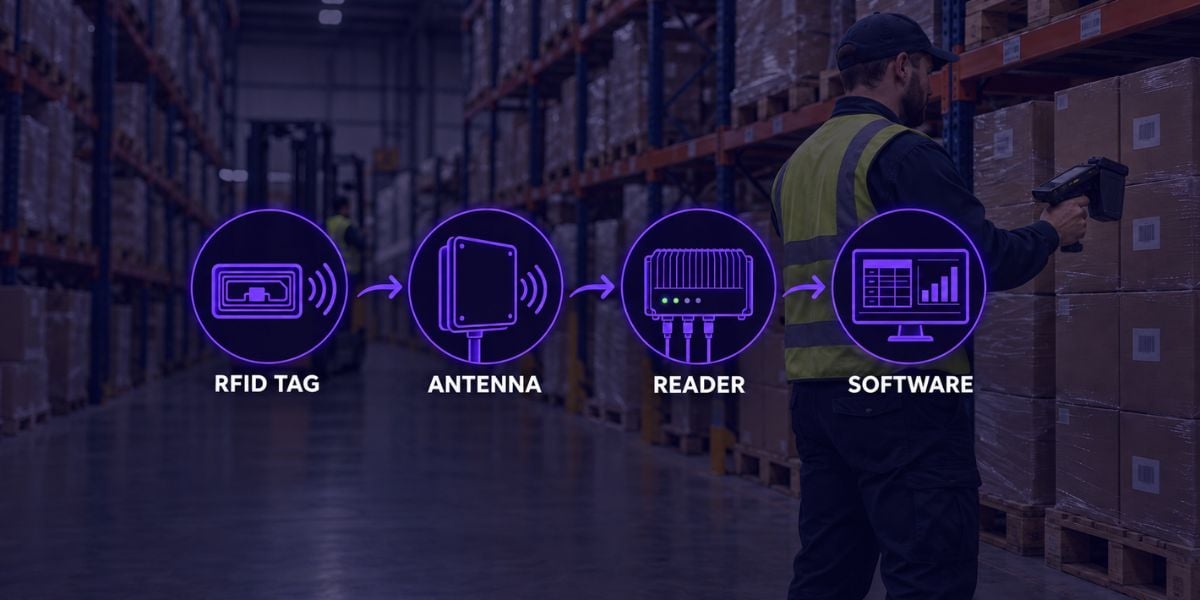
How Do RFID Tags Work, and Which Type Do You Need?
How do RFID tags work? See how the chip, antenna and power source work together, then match a tag to your surface and read range.

My Cart
—
Incl. VAT
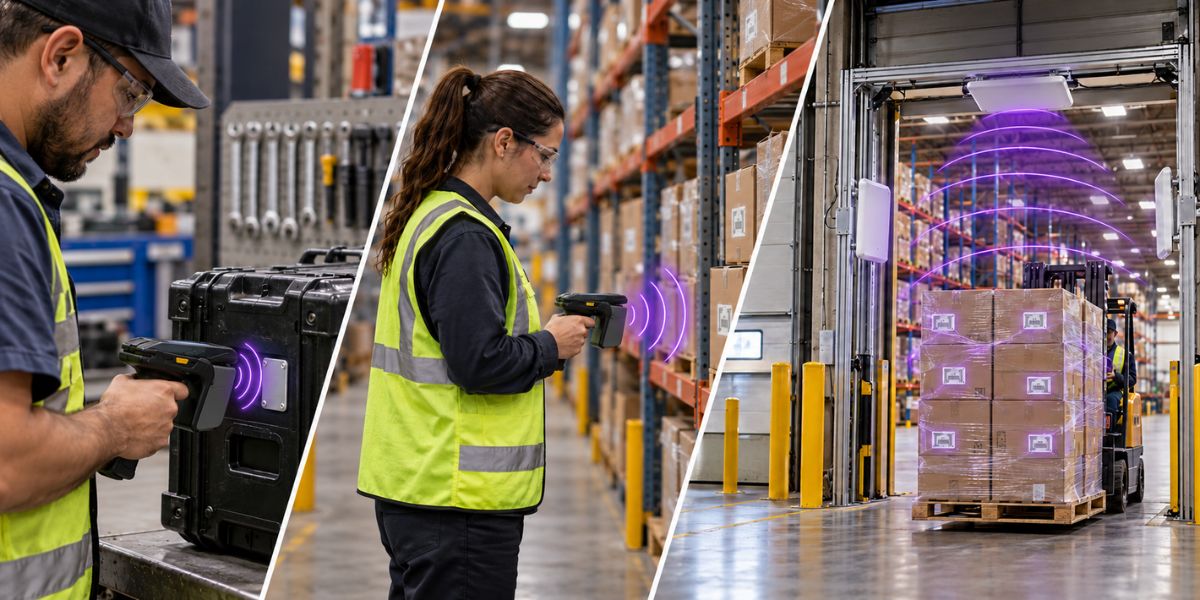
RFID runs on three frequency bands, low frequency (LF), high frequency (HF), and ultra high frequency (UHF), and each one trades range for cost and sensitivity to metal and liquid. LF reads from a few centimeters and works through metal and liquid, HF reads up to about a meter and covers access cards and NFC, and UHF reads up to about 30 feet and runs most supply chain and retail RFID.
| LF | HF | UHF | |
|---|---|---|---|
| Frequency range | 125 to 134 kHz | 13.56 MHz | 860 to 960 MHz (plus 433 MHz for active) |
| Typical read range | Near contact to about 4 inches | A few inches up to about 3 feet | Up to about 30 feet passive, 100+ feet active |
| Standard | ISO 18000-2 | ISO 18000-3, ISO 14443, ISO 15693, NFC Forum | ISO 18000-6 (EPC Gen2) |
| US regulation | FCC Part 15.225 | FCC Part 15.225 | FCC Part 15.247, 902 to 928 MHz, 4W EIRP |
| EU regulation | ETSI EN 300 330 | ETSI EN 300 330 | ETSI EN 302 208, 865 to 868 MHz, 2W ERP |
| Works through metal and liquid | Yes | Limited | No, needs on-metal tag design |
| Common uses | Access control, animal ID | Access badges, library books, payment and NFC | Supply chain, retail inventory, dock doors, asset tracking |
The three RFID frequency bands are low frequency (LF), high frequency (HF), and ultra high frequency (UHF), and they sit at different points on the radio spectrum the same way AM, FM, and satellite radio do. ISO's 18000 series defines the air interface for each one separately, which is why an LF reader can't talk to a UHF tag, they're built for different parts of the spectrum entirely.
Picking a band isn't about which one is best, it's about which tradeoff fits the job. LF and HF use magnetic coupling and stay useful at close range, even through metal and liquid. UHF uses radio backscatter and trades that short-range toughness for much longer range, which is why it dominates supply chain and retail applications where RFID tags need to be read from several feet away without lining up each item.
LF RFID is the low frequency band, operating at 125 to 134 kHz with a read range from near contact to about 4 inches. It's the shortest range of the three bands, and also the most tolerant of metal and liquid, since its long wavelength and magnetic coupling pass through both with little interference.
That tolerance is the whole reason LF still gets used despite its short range. Animal identification tags, which have to read reliably through tissue and fluid, almost always run on LF. Access control systems that only need to confirm a badge is held right up to the reader also use LF, since the short range itself works like a built-in security feature, nobody can read the tag from across the room. ISO 18000-2 defines the air interface for systems operating below 135 kHz.
HF RFID is the high frequency band, operating at 13.56 MHz with a read range from a few inches up to about 3 feet depending on the standard and antenna. It sits in the middle of the three bands on both range and cost, and it's the band behind NFC, so it's the one most people have actually touched, tapping a badge or a phone against a reader.
HF splits into two main standards depending on how much range the application needs. ISO 14443, the standard behind most access badges and NFC payments, is built for tap-range reads of a few centimeters. ISO 15693, the vicinity-card standard, reaches further, up to about a meter with a good antenna, and shows up in library book tracking and light asset tags. Like LF, HF handles metal and liquid better than UHF does, though not as well as LF.
UHF RFID is the ultra high frequency band, operating at 860 to 960 MHz for passive tags with a read range up to about 30 feet, which is what makes it the band behind most supply chain and retail RFID. A separate 433 MHz UHF band, covered by ISO 18000-7, is used for active tags that carry their own battery and reach much further.
GS1's EPC Gen2 standard, built on ISO 18000-6C, is the UHF standard behind most commercial tags and readers, including the fixed RFID readers mounted at dock doors and checkpoints across warehouses. For the fundamentals of how a UHF reader and tag actually communicate, see our guide to what RFID is and how it works.
Read range is the single biggest practical difference between the three bands, and it runs from inches to tens of feet across them. LF reads from near contact to about 4 inches, HF reads from a few inches up to about 3 feet, and passive UHF reads up to about 30 feet, with active UHF tags reaching well past 100 feet.
Actual range in the field always comes in under the spec sheet number. Reader power, antenna size, tag orientation, and what the tag is mounted on all pull range down from the ideal lab conditions those figures assume. A full breakdown of how passive and active UHF compare on range, cost, and battery life is in our guide to passive versus active RFID.
RFID frequency regulation does differ by country, mainly for UHF, where the US and Europe use different slices of the band at different power limits. LF and HF are harmonized closely enough worldwide that regulation rarely changes a buying decision, but UHF hardware bought for one region often underperforms or fails compliance in another.
| FCC, United States | ETSI, Europe | |
|---|---|---|
| Band | 902 to 928 MHz | 865 to 868 MHz |
| Power limit | 4W EIRP | 2W ERP |
| Standard | FCC Part 15.247 | ETSI EN 302 208 |
In the US, UHF RFID operates under FCC Part 15.247, covering the full 902 to 928 MHz band at up to 4 watts EIRP. In Europe, ETSI EN 302 208 covers a narrower 865 to 868 MHz band at up to 2 watts ERP, with stricter channel rules. A reader or tag built for the US band can perform noticeably worse, or fail certification outright, if it's deployed in Europe without checking the regional standard first.
Metal and liquid affect all three RFID frequencies, but LF and HF tolerate both far better than standard UHF tags do. LF's long wavelength and magnetic coupling pass through metal and liquid with little disruption, which is exactly why it's the default for animal tags and fluid-heavy environments.
UHF is the most exposed to interference from both. Metal reflects UHF radio waves and can detune a standard tag's antenna, while liquid absorbs the signal outright. Specialized on-metal UHF tags, built with a spacer layer or a different antenna design, solve this for most supply chain cases, but they cost more than a standard label and still don't match LF's tolerance in heavy fluid environments.
Choosing the right RFID frequency comes down to matching read range and material tolerance to the job, more than picking the newest or fastest option. A short-range, metal-tolerant application points to LF. A tap-range access or payment use case points to HF. Anything that needs to read items from several feet away, especially at volume, points to UHF.
| Choose LF | Choose HF | Choose UHF | |
|---|---|---|---|
| Profile | Close range, tough materials | Tap range, NFC compatible | Long range, high volume |
| Typical use cases | Reads through metal or liquid; animal identification; near-contact access control | Access badges and payment; library and media tracking; phone and smart device taps | Reads dozens of tags at once; dock door checkpoints; retail inventory tracking |
Most warehouse and retail deployments land on UHF because the combination of long range and fast multi-tag reads is what makes bulk counts and dock-door checkpoints practical in the first place. LF and HF stay in use because nothing about UHF's range advantage helps with a badge tap or a tag that has to read through a water bottle.
Most tags are built for a single frequency because the antenna design is specific to the wavelength it's tuned for. A small number of multi-protocol chips combine HF and UHF on one inlay, but a true single tag spanning LF, HF, and UHF isn't standard.
No. The 860 to 960 MHz range is shared globally, but the exact band and power limit are set by each region's regulator, 902 to 928 MHz in the US under FCC rules, 865 to 868 MHz in Europe under ETSI rules, and other bands elsewhere. Hardware built for one region can underperform in another.
NFC Forum standardized on 13.56 MHz specifically so phones, tags, and readers from different manufacturers would reliably work together, rather than each supporting a different slice of the broader 3 to 30 MHz HF band.
Generally yes among LF, HF, and UHF, but it's not a straight line. UHF's range comes from backscatter radio rather than frequency alone, and factors like antenna size and reader power change actual range more than frequency does within a band.
For most warehouse, retail, and supply chain applications, UHF is the frequency that makes sense, long range and fast multi-tag reads are what the job actually needs. LF and HF still matter for the applications built around their strengths, close-range security, metal and liquid tolerance, and tap-based access.
Speak to an Expert. If you're not sure which frequency fits your application, talk to a Levata specialist about a deployment built around your actual range, environment, and budget.
How do RFID tags work? See how the chip, antenna and power source work together, then match a tag to your surface and read range.
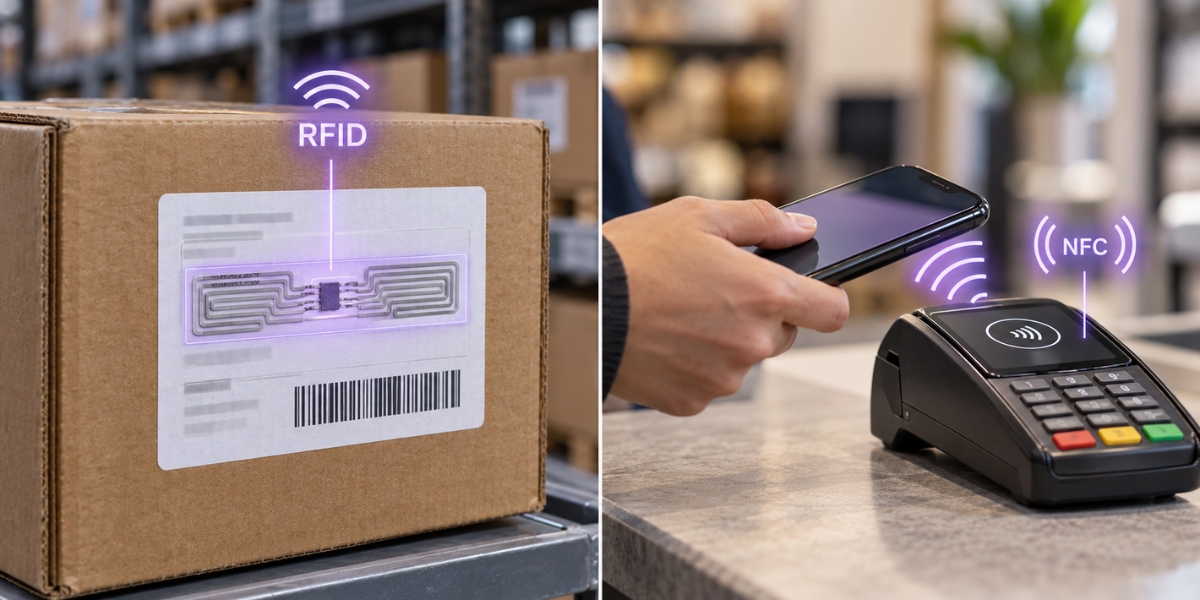
See how RFID and NFC differ on range, standards, and use, plus which one fits inventory tracking versus payments and access.
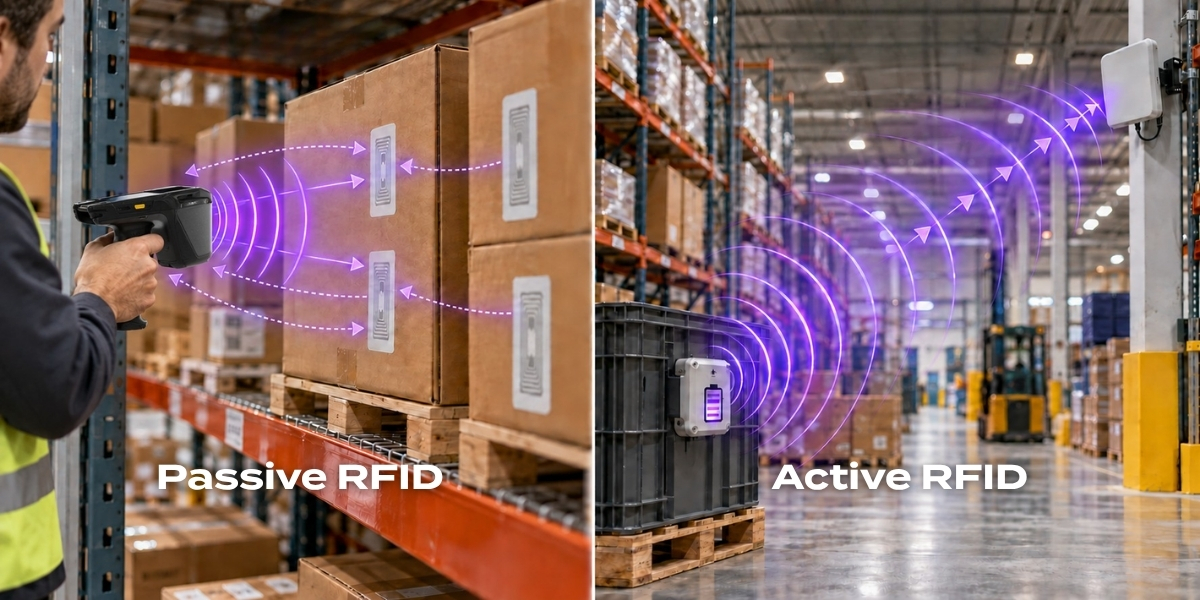
Compare passive and active RFID on cost, read range, and lifespan, plus when each type fits your warehouse, yard, or asset tracking needs.
Welcome, ID Card Group customers!
On September 24th, IDCardGroup.com transitioned to Levata.com. You still have access to the ID solutions you rely on, along with a broader selection of data capture and technology solutions.
What you can expect:
Questions? Call 1-833-353-8282.
Thank you for choosing Levata.
Welcome, IT Planet customers!
On September 24th, ITPlanet.com transitioned to Levata.com. You still have access to the products you rely on, along with a broader selection of data capture and technology solutions.
What you can expect:
Questions? Call 1-833-353-8282.
Thank you for choosing Levata.
Welcome, Barcode Planet customers!
On September 24th, BarcodePlanet.com transitioned to Levata.com. You still have access to the products you rely on, along with a broader selection of data capture and technology solutions.
What you can expect:
Questions? Call 1-833-353-8282.
Thank you for choosing Levata.