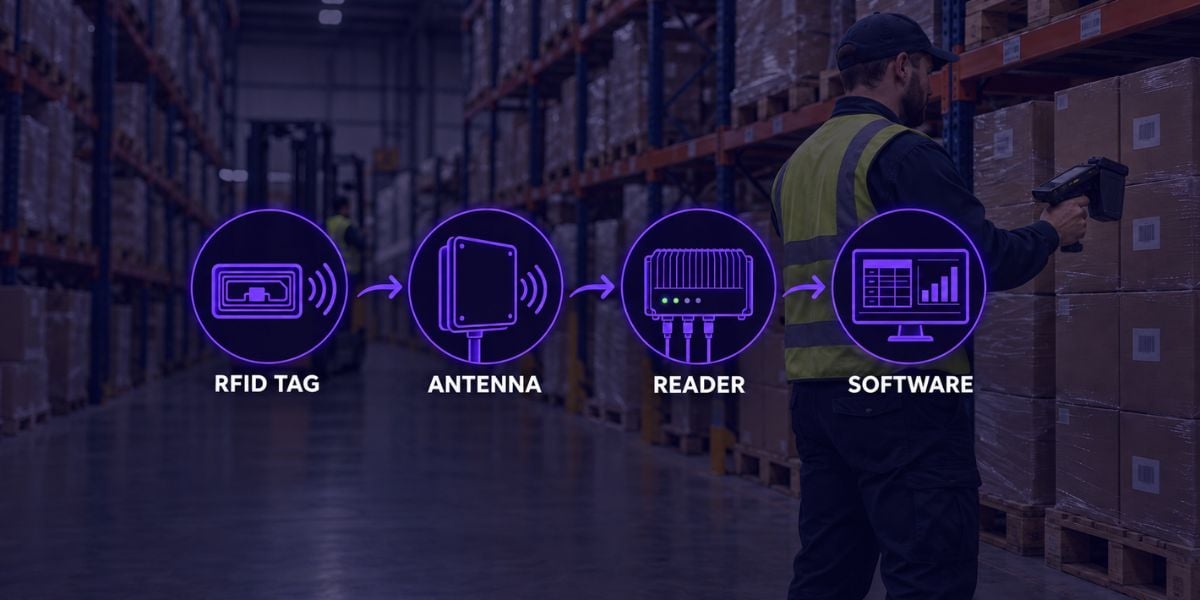
How Do RFID Tags Work, and Which Type Do You Need?
How do RFID tags work? See how the chip, antenna and power source work together, then match a tag to your surface and read range.

My Cart
—
Incl. VAT
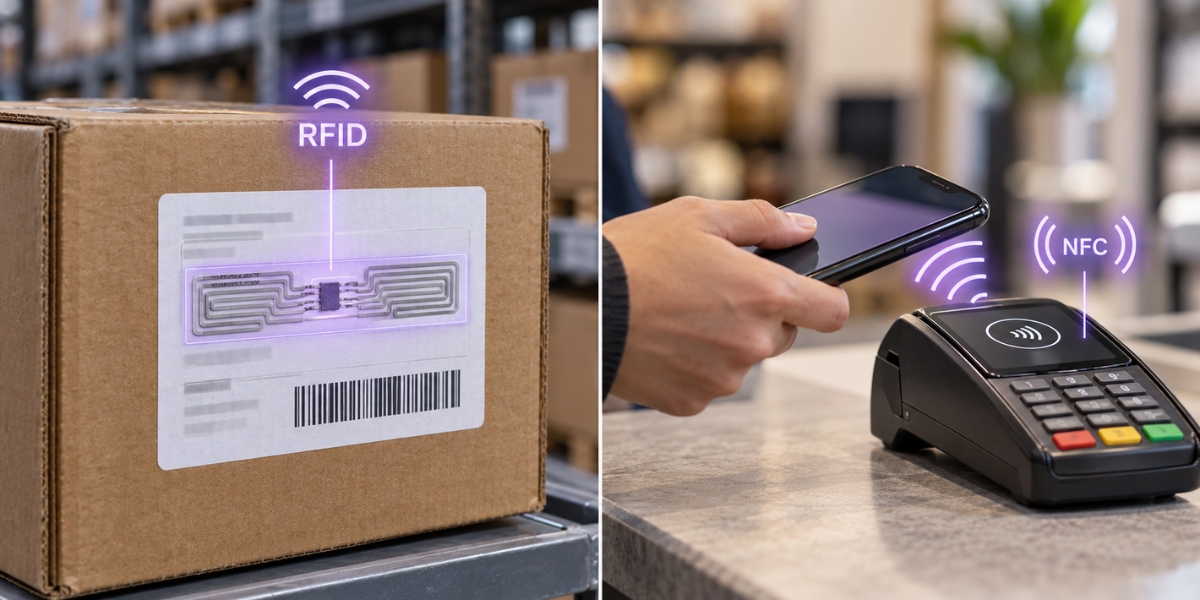
RFID is a broad wireless identification technology that reads tags from inches to over 100 feet away, while NFC is a short-range subset of RFID limited to about 4 centimeters, built for secure, tap-based exchanges between two devices. The choice comes down to range and purpose: RFID fits inventory and asset tracking, NFC fits payments, access badges, and device pairing.
| RFID | NFC | |
|---|---|---|
| Frequency | LF, HF, or UHF (125 kHz to 960 MHz) | HF only, 13.56 MHz |
| Typical read range | Inches (LF/HF) up to 30+ feet (UHF), 100+ feet active | About 4 cm, 2 cm certified compliant range |
| Communication | Reader to tag, one direction | Device to device, two directions (peer to peer) |
| Standard | ISO 18000 series, EPC Gen2 | ISO 14443, ISO 18092, NFC Forum |
| Multiple reads at once | Yes, dozens of tags in one pass | No, one device at a time |
| Common uses | Inventory, supply chain, asset tracking | Payments, access badges, device pairing |
NFC is a type of RFID, specifically a subset of high frequency (HF) RFID built for short-range, two-way communication. Both NFC and HF RFID operate at the same 13.56 MHz frequency, and NFC's standards, including ISO 14443 and ISO 18092, are built on RFID standards.
The difference isn't the radio, it's what the device does with it. A standard HF RFID reader only reads tags, one direction, reader to tag. NFC adds peer-to-peer communication, letting two NFC devices, like a phone and a payment terminal, talk to each other in both directions. That's the feature that makes NFC useful for tap-to-pay and device pairing, not just tag reading.
RFID is radio frequency identification, a technology that reads tags using radio waves across three frequency bands, LF, HF, and UHF, with read ranges from inches to over 100 feet. A basic RFID system has a tag, a reader, and an antenna, and most deployments can read dozens of tags in a single pass without lining each one up.
That range and bulk-read capability is what makes RFID the technology behind supply chain, retail inventory, and asset tracking, where speed and volume matter more than tap-to-tap interaction. For the fundamentals of how the reader, tag, and antenna work together, see our guide to what RFID is and how it works.
NFC is near field communication, a short-range wireless standard operating at 13.56 MHz with a typical range of about 4 centimeters. The NFC Forum, the nonprofit standards body behind NFC, certifies device compliance and defines the specifications that let phones, tags, and readers from different manufacturers work together reliably.
NFC's short range is a deliberate design choice, not a limitation. Requiring devices to be held within a few centimeters of each other makes accidental or unauthorized reads far less likely, which is part of why NFC became the standard for contactless payment and secure access. In June 2025, the NFC Forum's Release 15 raised the certified compliant operating range from 0.5 cm to 2 cm, a fourfold increase aimed at making taps more reliable without requiring precise alignment.
Read range is the biggest practical difference between RFID and NFC, and it isn't close. NFC tops out around 4 centimeters, while RFID spans a much wider range depending on frequency, from a few inches on LF up to about 30 feet on passive UHF, and well past 100 feet on active UHF tags.
| Read range | |
|---|---|
| NFC | About 4 cm |
| Passive UHF RFID | Up to about 30 ft |
| Active RFID | 100+ ft |
Impinj puts typical passive UHF RFID range at up to 10 meters, about 30 feet. Link Labs notes active RFID tags, which carry their own battery, commonly reach well past 100 feet. That gap in range is exactly why the two technologies split into such different use cases, one is built to read from a distance, the other is built to require closeness. A full breakdown of RFID's own frequency bands, including where HF and UHF differ, is in our RFID frequency guide.
NFC is generally considered more secure than standard RFID, mainly because its short range limits who can even attempt a read. A would-be attacker has to get within centimeters of an NFC device, while some RFID tags can be read from across a room, which widens the window for unauthorized scanning.
That said, security depends more on how a system is configured than on the technology alone. RFID tags can be locked or encrypted, and plenty of RFID deployments, including access badges and secure asset tracking, are built with strong protections. NFC's peer-to-peer capability also adds its own considerations, since a two-way exchange creates a different kind of attack surface than a one-way tag read. Neither technology is automatically secure or insecure, the deployment determines that.
RFID is the right choice whenever you need to read items from a distance or read many items at once. Warehouse inventory counts, dock-door checkpoints, and asset tracking all depend on reading dozens of RFID tags in a single pass, something NFC's one-at-a-time, centimeter-range design simply can't do.
RFID also wins whenever line of sight or manual scanning isn't practical. A UHF reader can pick up tags through packaging, on a moving pallet, or across a dock door without anyone tapping a single item.
| Choose RFID | Choose NFC |
|---|---|
| Warehouse inventory counts | Contactless payment |
| Dock door checkpoints | Access badges and door taps |
| Asset and equipment tracking | Device pairing and smart posters |
NFC is the right choice whenever the interaction is meant to be deliberate, close, and one-to-one. Contactless payment, access badges tapped at a door, and pairing two devices all depend on NFC's short range and two-way communication, not on reading dozens of items from across a room.
NFC also fits marketing and product use cases where a customer taps a phone to a poster, package, or product tag to pull up information. That kind of intentional, single-tap interaction is exactly what NFC's range and peer-to-peer design were built for, and it's not something standard RFID is built to replicate.
Not usually. NFC devices can read NFC-compliant tags and some HF RFID tags built to the ISO 15693 standard, but they can't read LF or UHF RFID tags, which operate on different frequencies entirely.
Your phone uses NFC. Phone-based tap-to-pay, transit cards, and tag scanning all run on NFC, which is why your phone has to be held within a few centimeters of a reader or tag to work.
No. UHF RFID operates at 860 to 960 MHz with a read range up to 30 feet or more, while NFC operates at 13.56 MHz with a range of about 4 centimeters. They don't share a frequency and can't communicate with each other.
Some multi-protocol inlays combine an HF/NFC chip and a UHF RFID chip on one tag, letting it work both as an NFC-readable tag and a long-range UHF tag. A standard single-frequency tag can't do both.
If the job is reading a lot of items from a distance, RFID is the technology built for it. If the job is a deliberate, close-range tap, for a payment, a badge, or a device pairing, NFC is the better fit. The two aren't competing options so much as different tools built for different distances.
Speak to an Expert. If you're not sure whether RFID or NFC fits your application, talk to a Levata specialist about a deployment built around your actual use case.
How do RFID tags work? See how the chip, antenna and power source work together, then match a tag to your surface and read range.
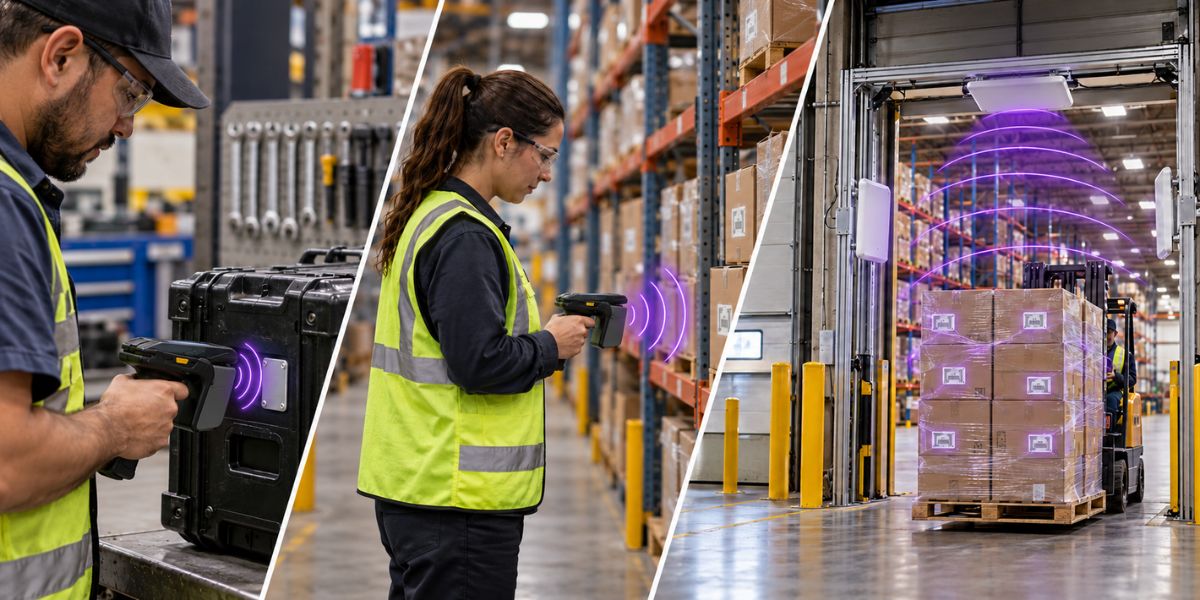
Compare LF, HF, and UHF RFID on range, standards, regulation, and best use, with a reference chart built to save and cite.
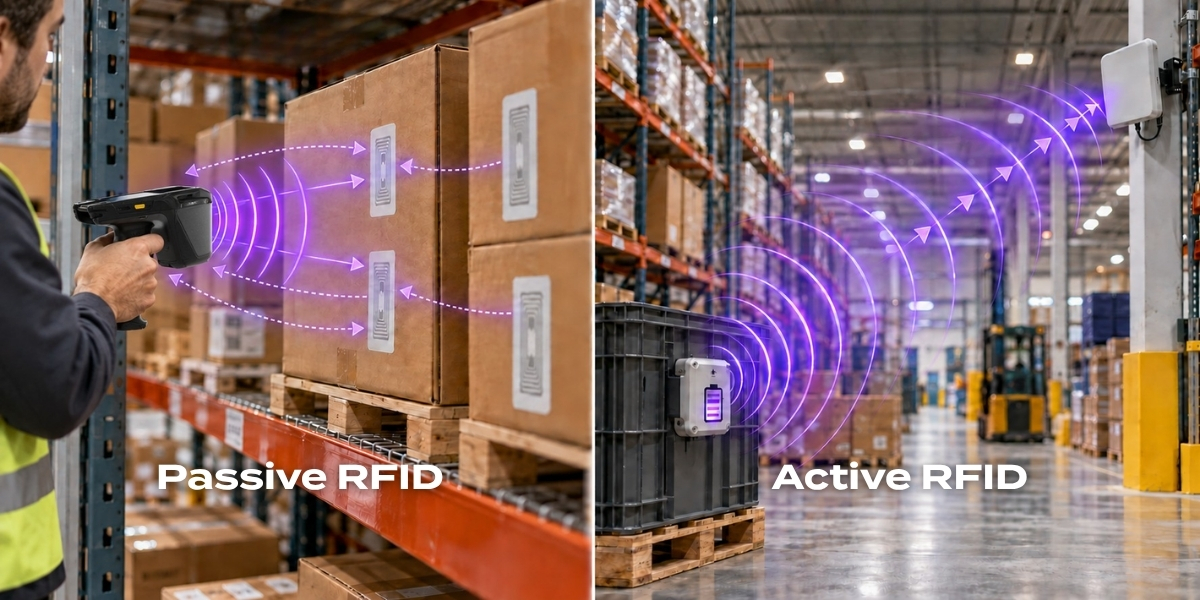
Compare passive and active RFID on cost, read range, and lifespan, plus when each type fits your warehouse, yard, or asset tracking needs.
Welcome, ID Card Group customers!
On September 24th, IDCardGroup.com transitioned to Levata.com. You still have access to the ID solutions you rely on, along with a broader selection of data capture and technology solutions.
What you can expect:
Questions? Call 1-833-353-8282.
Thank you for choosing Levata.
Welcome, IT Planet customers!
On September 24th, ITPlanet.com transitioned to Levata.com. You still have access to the products you rely on, along with a broader selection of data capture and technology solutions.
What you can expect:
Questions? Call 1-833-353-8282.
Thank you for choosing Levata.
Welcome, Barcode Planet customers!
On September 24th, BarcodePlanet.com transitioned to Levata.com. You still have access to the products you rely on, along with a broader selection of data capture and technology solutions.
What you can expect:
Questions? Call 1-833-353-8282.
Thank you for choosing Levata.