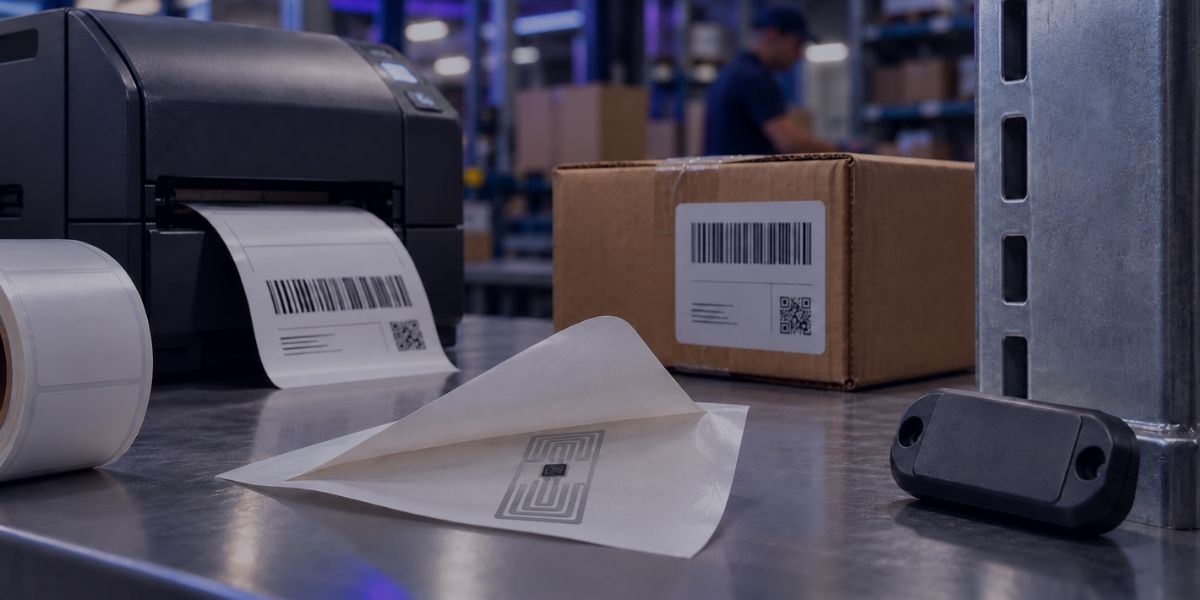
RFID Labels: Types, Printing, and When to Use Them Over Tags
RFID labels explained: the types, how to print and encode them, and when a hard tag is the better choice.

My Cart
—
Incl. VAT
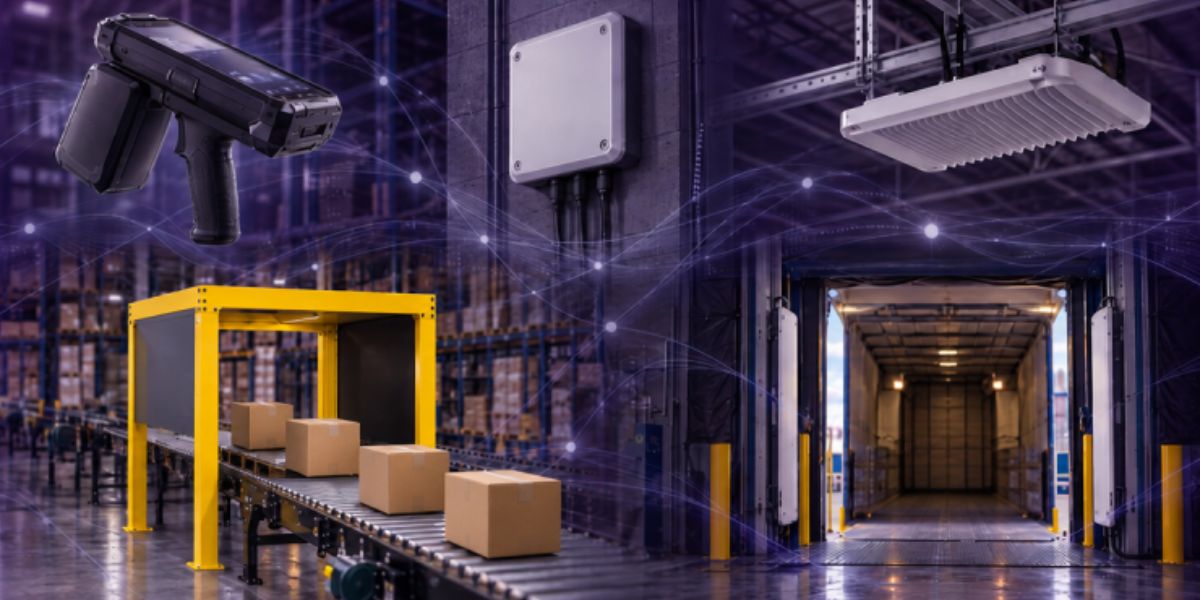
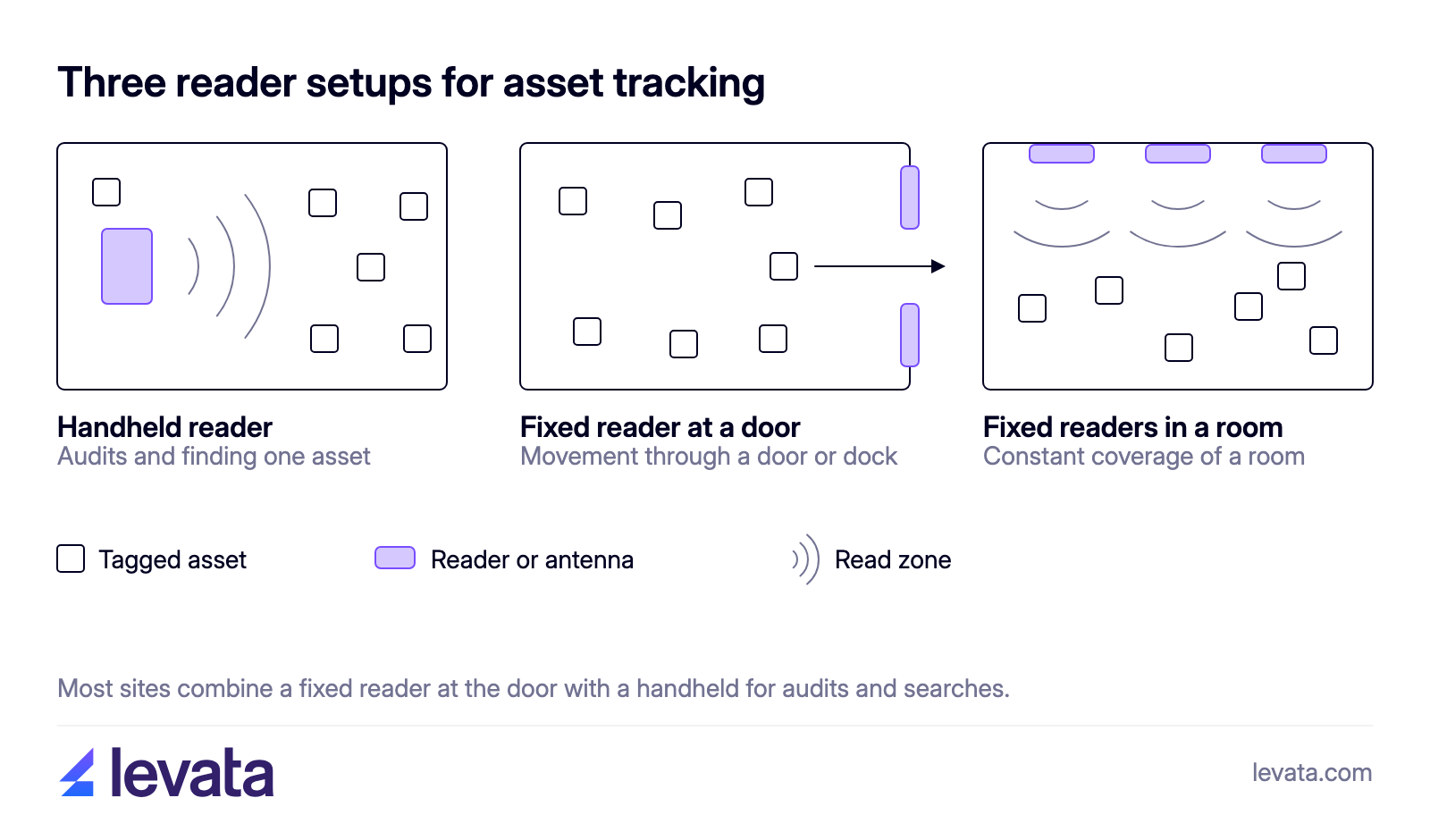
RFID asset tracking uses tags, readers and tracking software to create real-time asset visibility. As the operation expands, additional fixed antennas and RFID label printers are added. The type of RFID reader you pick sets the workflow. A handheld reader or sled fits audits and finding a lost item, a fixed reader at a doorway or dock fits movement tracking, and fixed readers with antennas fit constant coverage of a room.
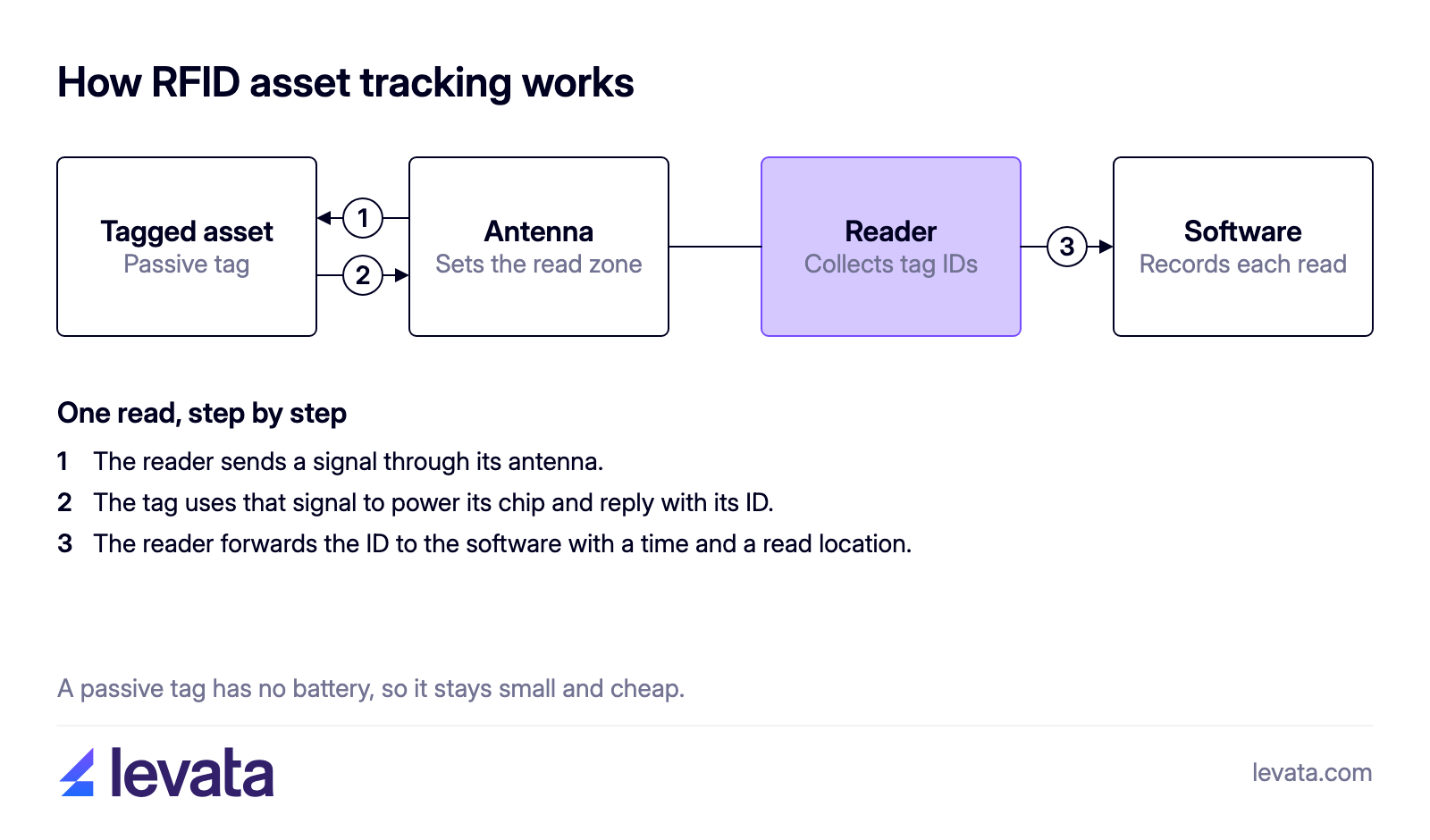
RFID asset tracking works by letting a reader identify a tagged asset by radio, then passing that identity to software that records where the asset is. The reader sends a signal through its antenna, a passive tag uses that signal to power its chip and reply with its ID, and the reader forwards the ID to the software with a time and a read location. A passive tag carries no battery, so it stays small and cheap.
Most business asset tracking uses UHF passive tags. The GS1 EPC Gen2 standard defines how UHF readers and passive tags communicate in the 860 MHz to 930 MHz range, and GS1 describes it as the standard for UHF passive RFID, also called RAIN RFID. Under ISO/IEC 18000-63, a tag replies only after the reader's signal directs it to, and the standard sets the method a reader uses to separate many tags in one zone.
Unlike a barcode, RFID needs no line of sight, and a fixed reader keeps scanning without a person, as GS1 US explains. The read zone depends on the antenna, the reader's power and the tag, so test with your own assets before you buy in volume.
An RFID asset tracking system needs tags on the assets, antennas and RFID readers to capture them, printers to make new tags, and software to record each read. Levata sells each piece, plus the services to install them.
| Piece | What it does | Choose it by | Levata page |
|---|---|---|---|
| Tags and labels | Give each asset an ID | Surface, environment and size | RFID tags and RFID labels |
| Handheld readers | Read tags as a person walks | How many assets one person audits | Handheld RFID readers |
| Fixed readers and antennas | Read tags at a fixed point | Where assets pass or stay | Fixed RFID readers |
| Printers | Print and encode new labels | How often you add assets | RFID printers |
| Software | Records and reports each read | Reports and system links you need | RFID tracking software |
The RFID tags and labels that fit your assets depend on what each asset is made of and where it sits. Metal and liquid change how a tag antenna behaves, so a paper label that reads well on a cardboard box can fail on a steel cabinet. Test candidate tags on a real asset before you order in bulk, which is how Levata's RFID team approaches projects.
Levata carries adhesive tags, hard tags and wristbands, and RFID labels in thermal transfer and direct thermal formats. Tags come in LF, HF and UHF, and UHF suits most asset tracking because readers reach farther.
Most asset tracking uses passive tags. A passive tag has no power source and is powered by the reader's field, while an active tag has an internal power source and can communicate with a reader continuously, so it reaches farther and suits vehicles across a large yard.
| Asset type | Tag format to test first | Why |
|---|---|---|
| Metal tools and equipment | On-metal hard tag | Built to work against metal surfaces |
| Plastic totes, bins and racks | Hard tag or durable label rated for the container | Containers are handled and reused often |
| IT equipment and office assets | Adhesive RFID label | Flat surface and easy to apply |
| New assets added all year | Printable RFID label | Print and encode on site |
The RFID readers and antennas you need come down to whether a person carries the reader or the reader stays fixed to a wall, door or ceiling. A handheld reader lets someone walk a room, count tagged assets and search for one asset by its ID. One example, the Zebra MC3330R is a pistol grip handheld reader. According to Zebra’s product specs, it has a circular polarized UHF antenna and a 2D imager, so one device reads both RFID tags and barcodes.
Handheld readers also come as sleds that attach to a mobile computer or phone, so check device compatibility first. A fixed reader stays in place and reads every tagged asset that passes its antennas. The Zebra FX7500 has 2 or 4 antenna ports, so one reader can run up to 4 antennas and cover a doorway or several spots in a room. Levata lists both types under RFID readers.
The RFID antennas shape the read zone. A circular polarized antenna reads tags at any angle, which suits assets that sit in random positions, while a linear antenna usually reaches farther but needs the tag lined up with it.
You match RFID hardware to your tracking workflow by starting with the question you need answered, such as what inventory or assets are in a room, where a particular asset is, or whether an asset left through a door. Each question points to a reader type, and the tags and add on equipment follow from there.
| Workflow | Question it answers | Reader or printer | Add ons |
|---|---|---|---|
| Audit a room or building | What do we own here? | Handheld reader | Tracking software with an asset list |
| Find one asset | Where is this item? | Handheld reader | Search by tag ID |
| Track doors and docks | Did it arrive or leave? | Fixed reader with antennas at the door | RFID dock doors; see the Adient case study |
| Watch a storeroom or cage | Is it still in the room? | Fixed reader with wall or ceiling antennas | Alerts in the software |
| Tag new assets | How does a new asset get an ID? | RFID printer | Printable RFID labels |
Most sites combine two workflows, usually a fixed reader at the door for movement and a handheld for audits and searches. A college tracking 7,500+ assets across 35 buildings cut audit time per classroom from 25 minutes to 5 minutes with mobile RFID readers and trained each user in under 10 minutes. See it for yourself in this Levata webinar.
Adient tracked 875,000 reusable shipping containers by tagging them and reading every tag at its dock doors, as the Adient case study describes. Adient supplies seating, interiors and electronics to automakers, and thousands of its containers, worth up to $1,500 each, had gone missing.
In workflow terms this is movement through doors. The solution placed SLS D-Series devices on either side of dock doors about 8 feet wide, and Speedway readers collected each container's identity, direction of travel and location. Software then monitored which containers were available and where they were.
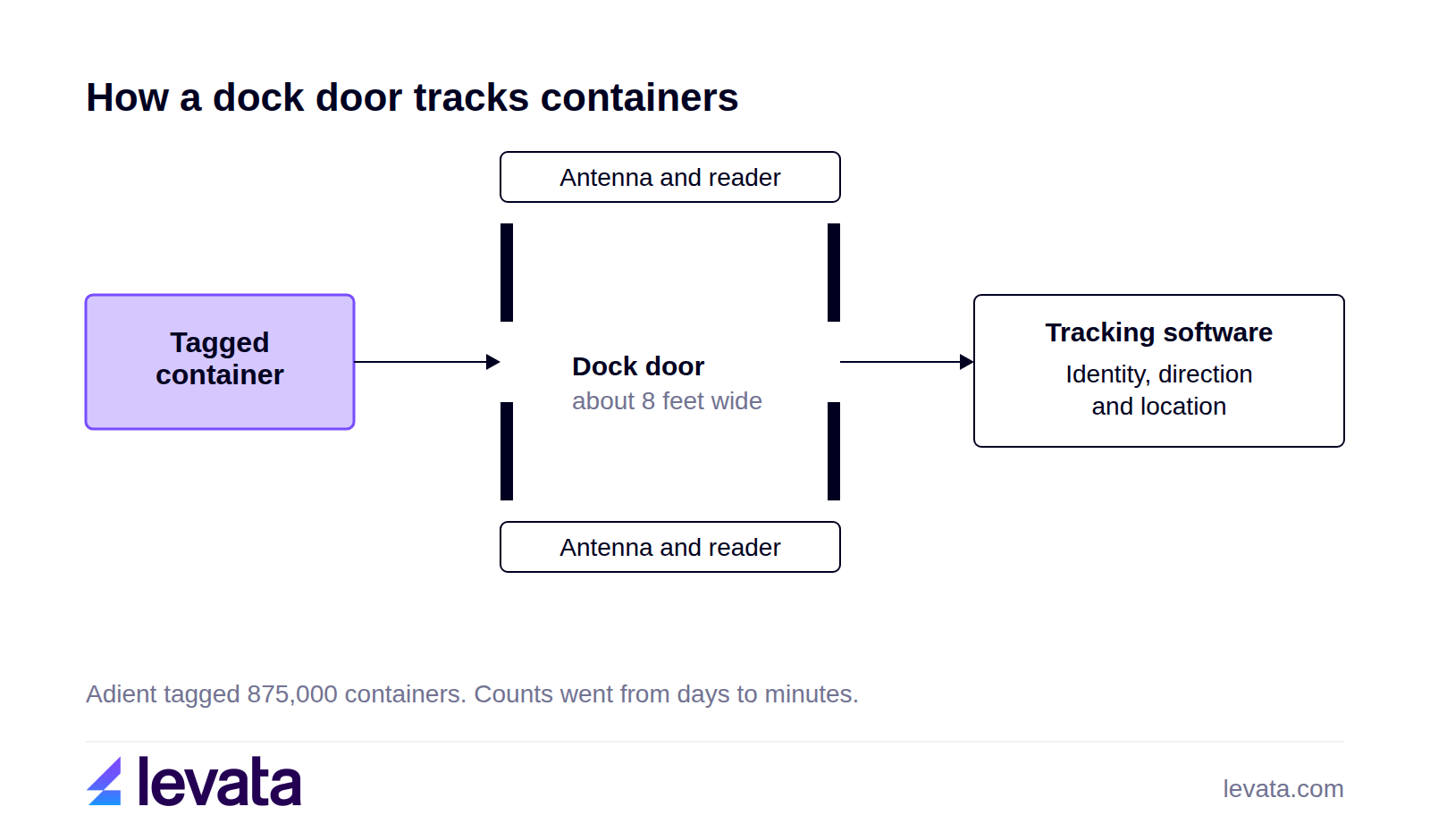
The results showed measurable ROI. Adient can see which customers keep empty containers, recover missing units, and count containers in minutes versus days, with 99% read accuracy on tagged items. Brian Kelly, Director of Supply Chain Management at Adient, summed it up: "If I have a distribution center sitting on containers for two days, I can see that. We're changing the paradigm. What we're saying is, 'This is an asset of Adient, and we want it back. We know where it is, and if you have it, we're going to come looking for it."
A barcode is enough for asset tracking when you have a modest number of assets, a person scans each one anyway, and nobody needs to know where an asset went between scans. Barcode labels cost less than RFID tags, and a barcode scanner with a label printer covers a small asset register well.
| Barcode | Handheld RFID | Fixed RFID | |
|---|---|---|---|
| How it reads | One label at a time, in line of sight | Many tags per pass, without line of sight | Tags passing the antennas |
| Needs a person to scan | Yes | Yes | No |
| Logs movement through a door | No | No | Yes |
| Hardware to buy | Scanner, labels, label printer | RFID handheld and tags | Fixed reader, antennas, tags, software |
RFID earns its higher cost when you count many assets often, when tags are hidden or out of reach, or when you need to know about movement. RFID also needs more setup, because metal, liquids and reader placement all affect results. GS1 US notes the two can complement each other, and many sites use both, with a barcode for a quick visual check and RFID for bulk reads.
You should pilot RFID asset tracking hardware on one workflow in one area before you buy for the whole site. A small pilot shows how your assets, surfaces and doors affect read results.
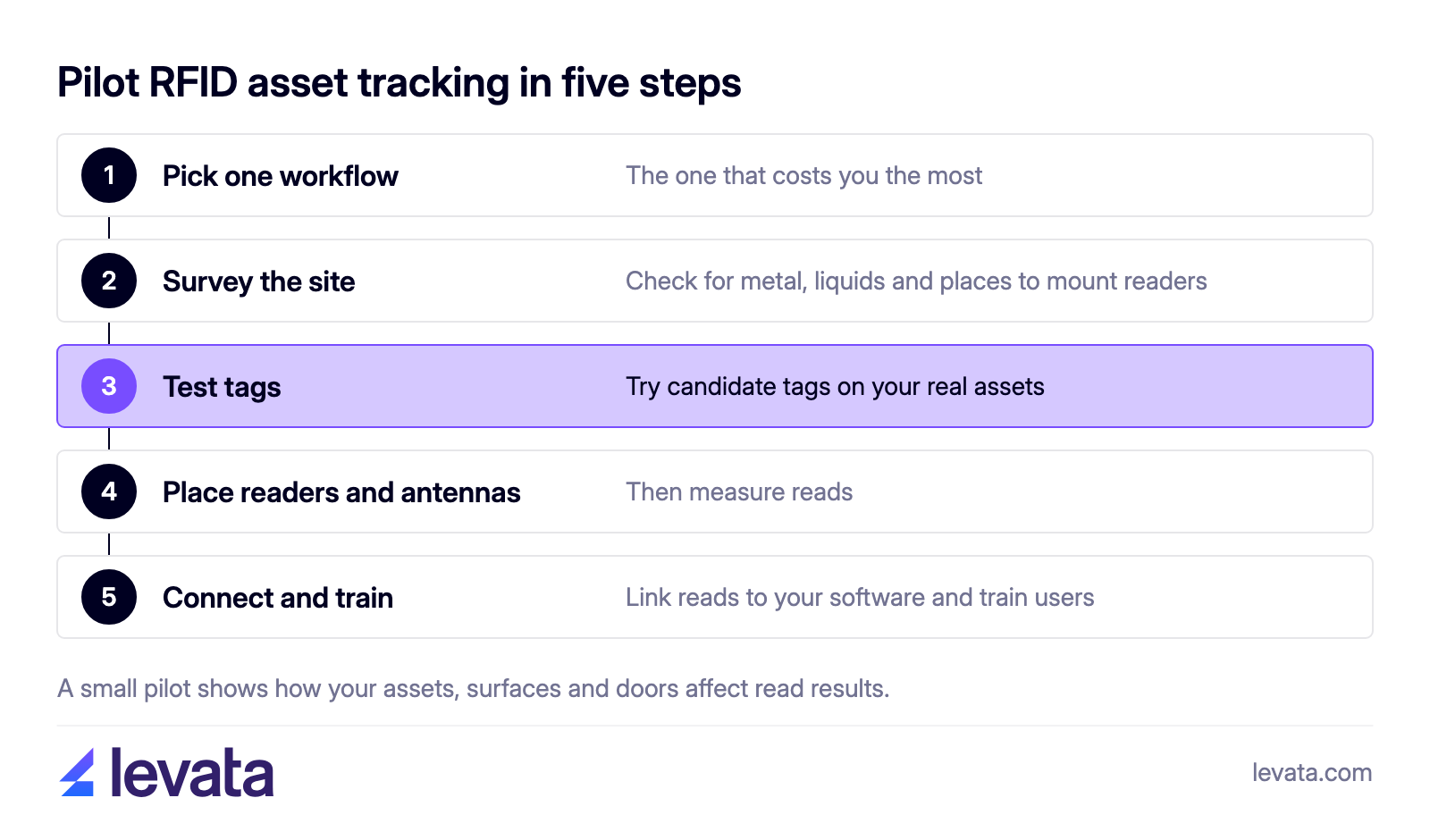
These RFID asset tracking hardware questions are the ones the sections above do not answer.
You need software, because a reader only reports tag IDs and times. Software links each ID to an asset record, shows the last read location and keeps history from check in to disposal. Some packages also alert you when a tagged asset leaves an authorized zone, so ask for that when you compare options. Levata sells RFID tracking software and can connect reads to your ERP or warehouse management system.
A starter setup usually pairs one handheld reader or sled, a set of tags and tracking software, sized to your asset count. Prices vary with asset count, location and reader choice, so a quote built on your numbers beats a list price.
Print them yourself if you add assets through the year, and consider buying them pre-encoded for a one time tagging project. An RFID printer writes the tag ID as it prints, so a new asset gets its label on the spot. Levata sells desktop, industrial and mobile RFID printers.
A fixed reader only sees assets at its read points, so an asset that leaves the site is out of view until it passes another reader. A door reader records when it goes out, and a handheld reader can check it when it returns. If you need live location off site, RFID alone will not provide it.
Results vary, but projects can return their cost in as little as six months, and the timing depends on what lost assets and manual counts cost you today.
Request a quote for RFID asset tracking hardware once you know which workflow you are starting with, because the workflow decides which reader you need, and the reader shapes the rest of the list. Tell Levata what you track, how many assets you have, what they are made of and whether they stay indoors or move outdoors. The Levata RFID team will propose the tags, readers, antennas, printers and software that fit.
RFID labels explained: the types, how to print and encode them, and when a hard tag is the better choice.
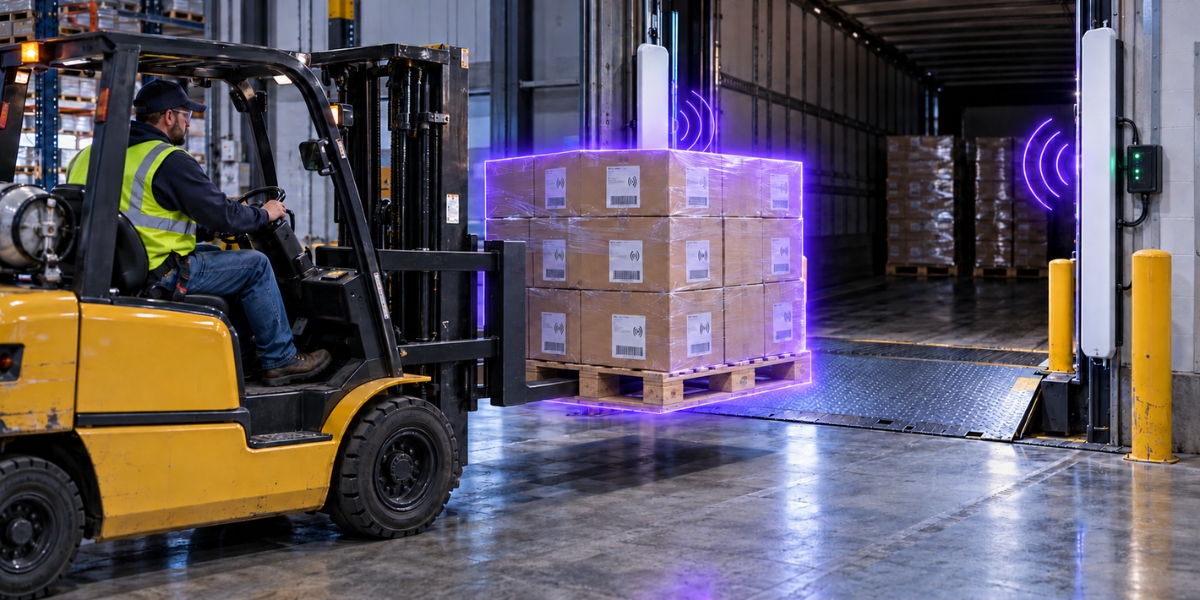
RFID inventory management cuts cycle counts from hours to minutes. See how warehouses and stores use it, what hardware to buy, and factors to know.
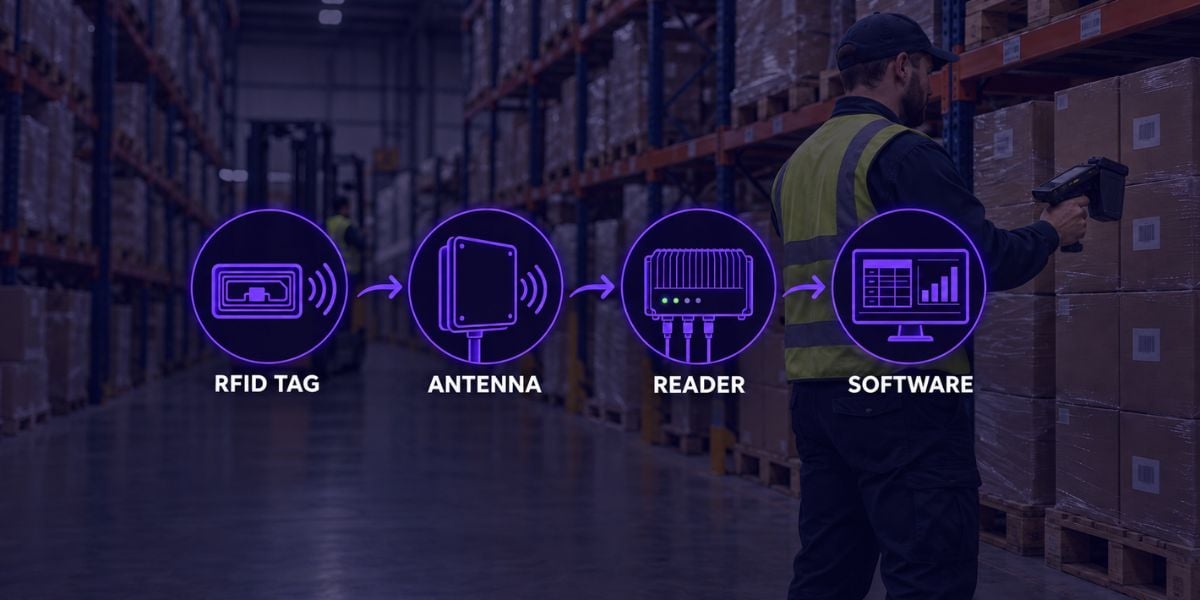
How do RFID tags work? See how the chip, antenna and power source work together, then match a tag to your surface and read range.
Welcome, ID Card Group customers!
On September 24th, IDCardGroup.com transitioned to Levata.com. You still have access to the ID solutions you rely on, along with a broader selection of data capture and technology solutions.
What you can expect:
Questions? Call 1-833-353-8282.
Thank you for choosing Levata.
Welcome, IT Planet customers!
On September 24th, ITPlanet.com transitioned to Levata.com. You still have access to the products you rely on, along with a broader selection of data capture and technology solutions.
What you can expect:
Questions? Call 1-833-353-8282.
Thank you for choosing Levata.
Welcome, Barcode Planet customers!
On September 24th, BarcodePlanet.com transitioned to Levata.com. You still have access to the products you rely on, along with a broader selection of data capture and technology solutions.
What you can expect:
Questions? Call 1-833-353-8282.
Thank you for choosing Levata.