The Best Rugged Laptops by Use Case
Find the best rugged laptop for your work environment. Compare fully rugged, semi-rugged and ruggedized models by rating, display, battery and price.

My Cart
—
Incl. VAT

Devices designed for rugged environments are intended to withstand environments that introduce dust and water elements. An IP65 means a device is dust-tight and protected against water jets, IP67 means dust-tight and protected against 30 minutes in 1 meter of water, and IP68 means dust-tight and protected against longer or deeper immersion that the maker sets. An IP rating is a two-digit code, the first digit grades dust and the second grades water, and a higher second digit does not always cover more, because the immersion levels leave out the jet tests unless the device is marked for both.
This guide gives the full IP rating chart, shows how the tests work, and explains which rating fits rugged tablets and rugged laptops.
Contents
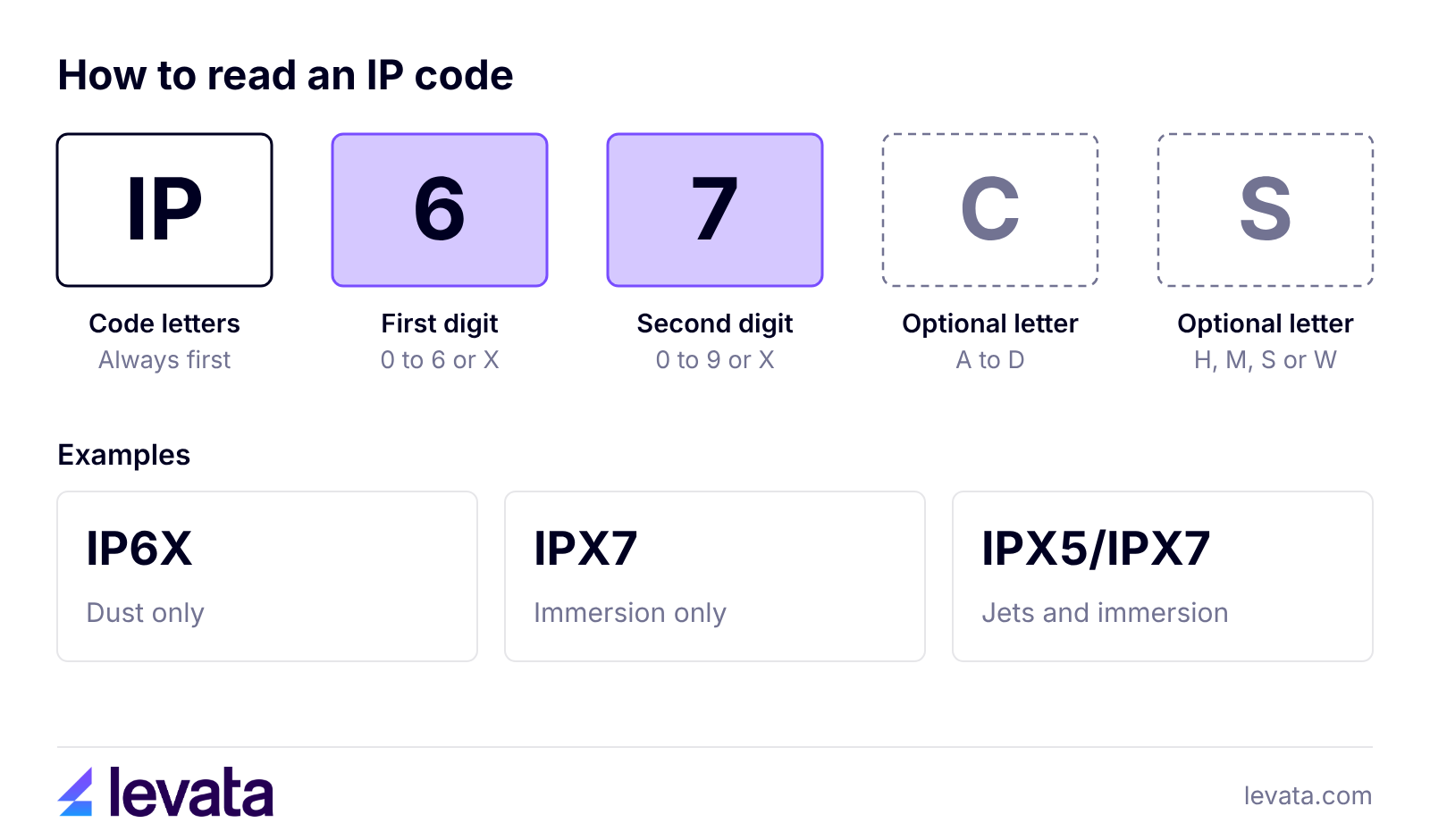
An IP rating is a code from the IEC 60529 standard that names which dust and water tests an enclosure passed. IP stands for ingress protection in everyday use, and the standard itself spells it out as international protection. The code is the letters IP followed by two digits, the first from 0 to 6 for solid objects and dust, and the second from 0 to 9 for water. An X in place of a digit means that test was not rated, so IPX7 makes no claim about dust.
The IEC writes the standard but does not certify products. The standard's foreword says the IEC provides no attestation of conformity, so an IP marking on a datasheet is the maker's claim that the device meets the tests. Some makers use outside labs, and Panasonic says independent laboratories certified its Toughbook ratings. When a rating decides a purchase, you may elect to ask for the test report.
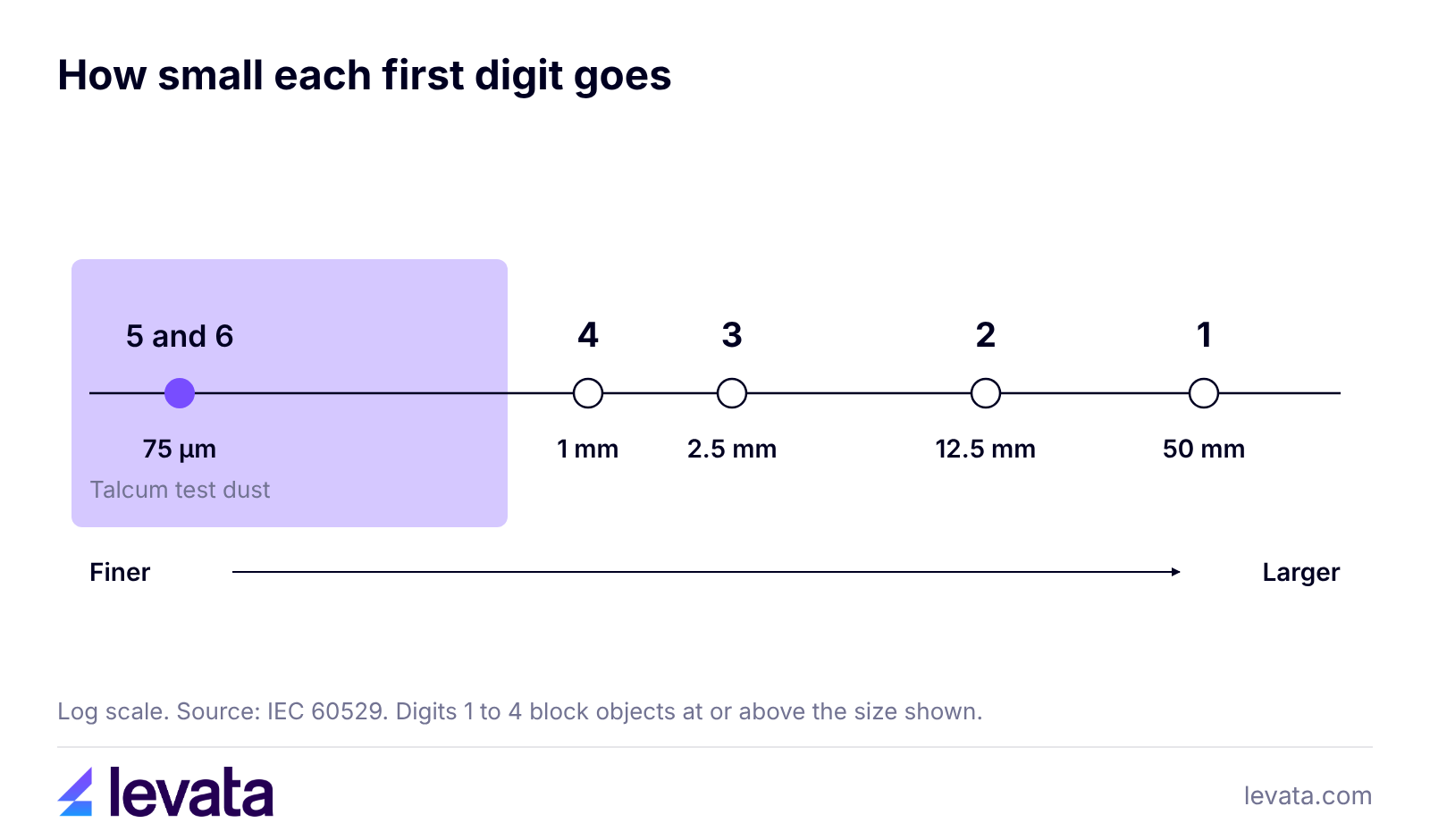
The first digit of an IP rating shows how well the enclosure keeps out solid objects and dust, from 0 for no protection to 6 for dust-tight. Levels 1 to 4 block objects at or above 50 mm, 12.5 mm, 2.5 mm and 1 mm. Levels 5 and 6 are the dust levels.
A level 5 device is dust-protected. Some dust can get in, but not enough to interfere with operation or safety. A level 6 device is dust-tight, and the test finds no dust deposit inside. The test uses talcum powder fine enough to pass a sieve with 75 micrometer gaps, with a vacuum drawing air through the enclosure for up to 8 hours.
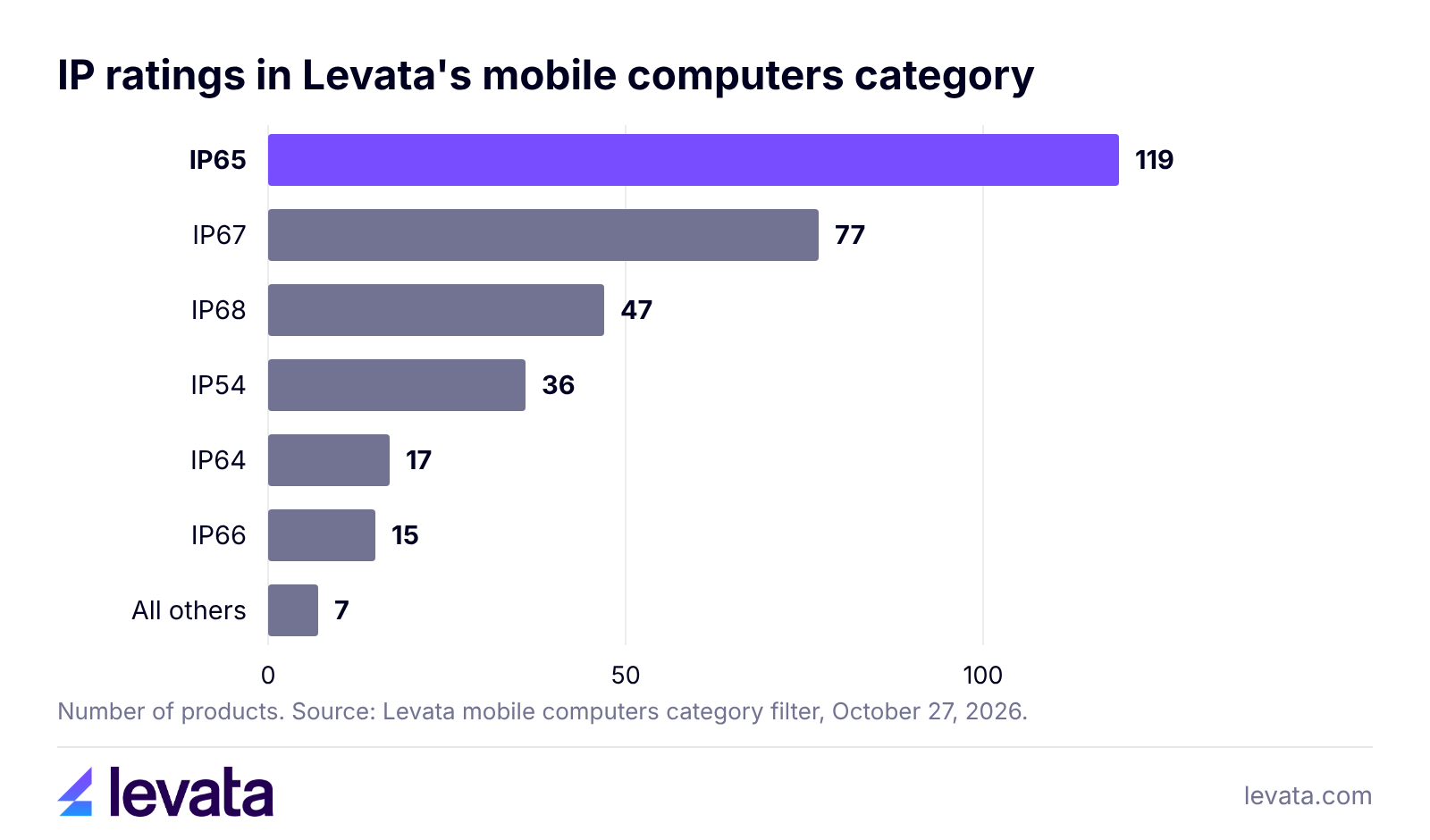
In Levata's mobile computers category, you can find listed IP ratings. If several have the same starting digit, then the second digit is where products differ.
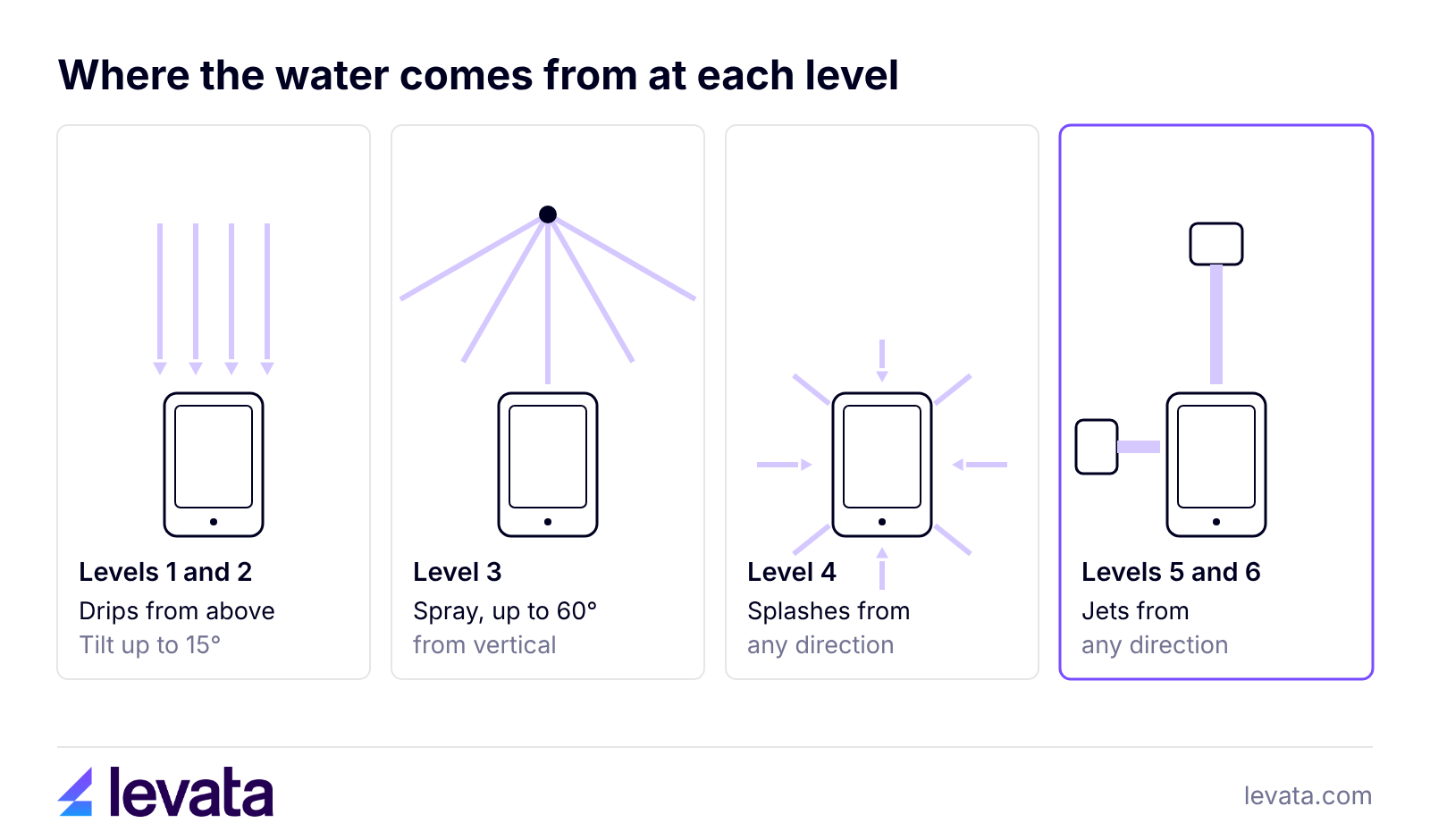
The second digit of an IP rating shows how well the enclosure keeps out water, from 0 for no protection to 9 for hot, high-pressure jets. Levels 1 and 2 cover vertical drips, and level 2 tilts the device up to 15 degrees. Level 3 covers spray at angles up to 60 degrees from vertical, and level 4 covers splashing from any direction.
Levels 5 and 6 cover water jets from any direction, levels 7 and 8 cover immersion, and level 9 covers hot jets at close range. Every one of these tests uses fresh water, so the digit does not tell you how a device handles salt water or cleaning chemicals.
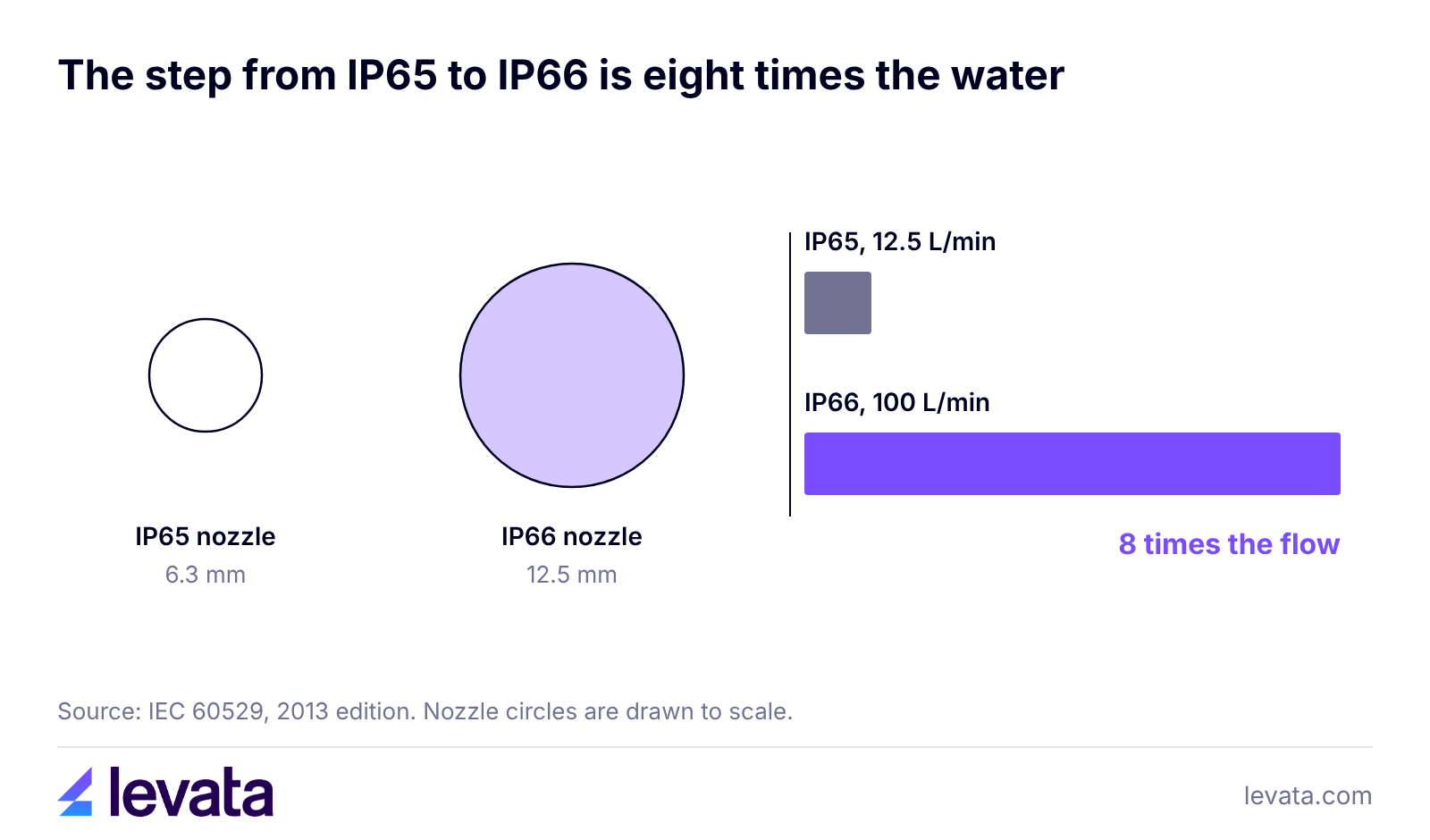
IP65 means the device is dust-tight and protected against water jets from any direction. The jet test uses a 6.3 mm nozzle at 12.5 liters per minute, aimed from 2.5 to 3 meters for at least 3 minutes. That covers rain, splashes and a light hose-down. It does not cover immersion.
IP65 is often the most common rating in the mobile computer category. Panasonic lists its Toughbook A3 and describes the G2 as water-resistant but not fully waterproof for immersion. Levata lists the Getac V110-G6 at IP65 in its rugged laptops range, and the Zebra ET45 rugged tablet at IP65.
IP66 is the next step. Its test uses a 12.5 mm nozzle at 100 liters per minute, which is 8 times the water of the IP65 test. Getac rates the G140 Rugged Tablet at IP66 for powerful water jets.
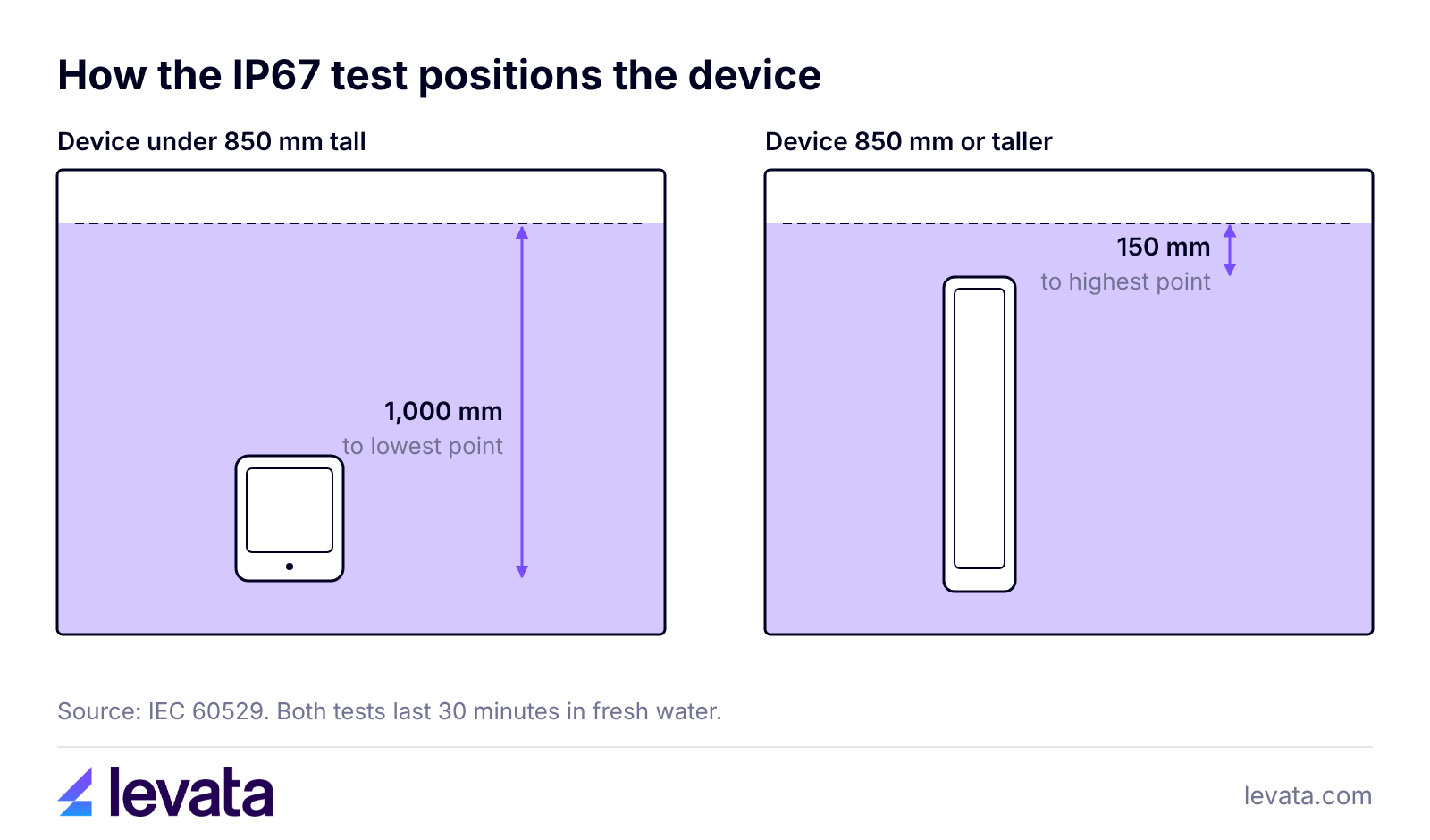
IP67 means the device is dust-tight and protected against temporary immersion in water. The test puts the lowest point of a device shorter than 850 mm 1 meter (1,000 mm) below the surface for 30 minutes. A device 850 mm or taller is tested with its highest point 150 mm below the surface.
IP67 covers a drop into a puddle, a bucket or a flooded floor. It does not claim protection against water jets by itself, and the higher ratings section below explains why. Levata lists the Honeywell CT30 XP and EDA52 handhelds at IP67.
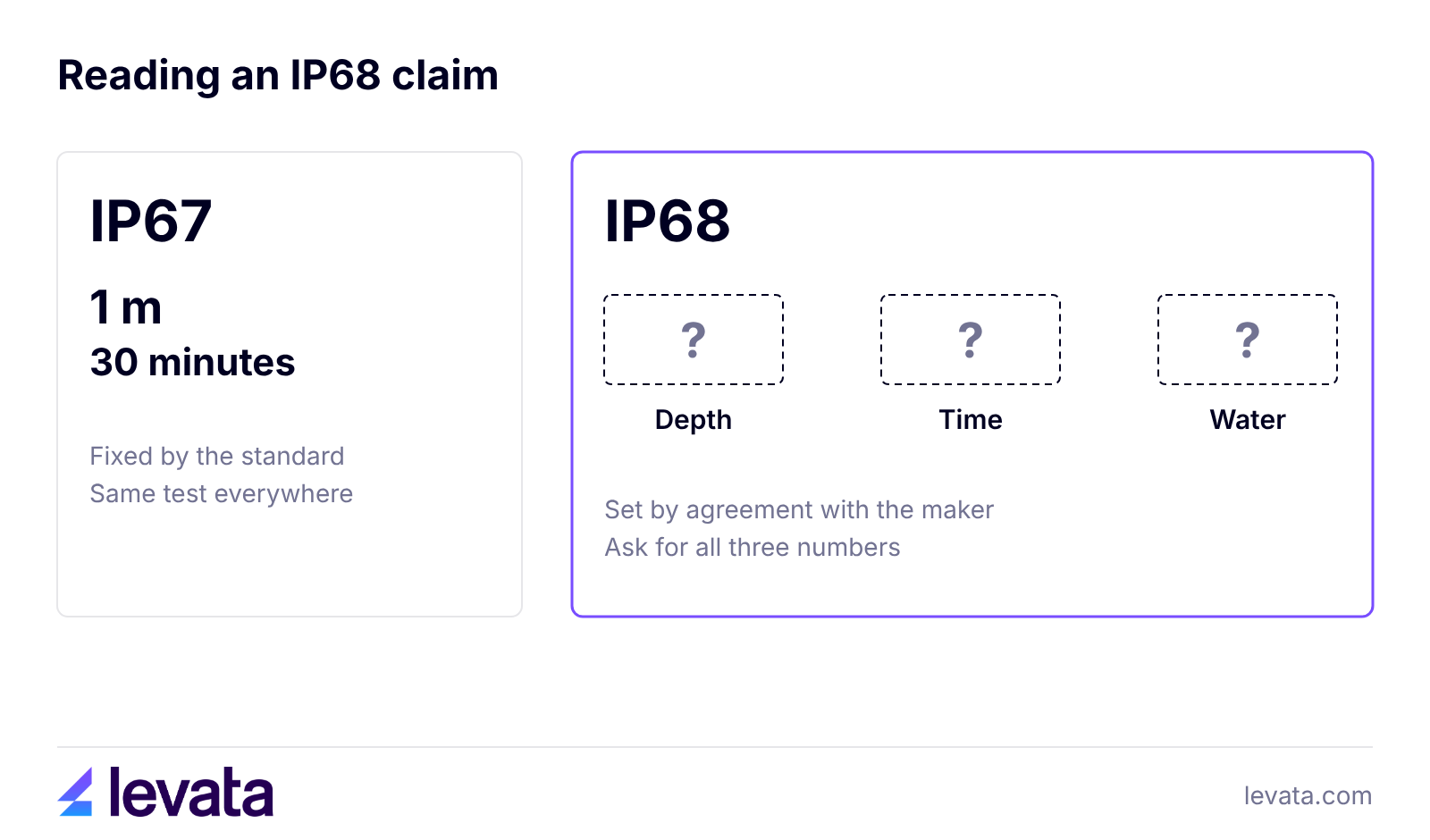
IP68 means the device is dust-tight and protected against continuous immersion in water. The standard does not fix the depth or the time. The maker and the buyer agree on them, and the test must be tougher than the IP67 test. In practice, the maker prints the numbers on the datasheet, so an IP68 claim is only as clear as the numbers printed next to it.
Read an IP68 line for three things: the depth, the time and the water. A tablet rated for a few minutes and one rated for hours can both say IP68 on the box. If a spec sheet gives only the code, ask the maker for those numbers before you rely on it. Levata lists the Honeywell CT45 XP handheld at IP65 and IP68, which shows both a jet claim and an immersion claim.
The full IP rating chart lists every first digit and second digit with the test behind it. Read the first digit from the first table and the second digit from the second table, so IP65 is dust-tight (6) and protected against water jets (5).
| First digit | Protection against solids | Test |
|---|---|---|
| 0 | No protection | No test |
| 1 | Objects 50 mm and larger | 50 mm sphere |
| 2 | Objects 12.5 mm and larger | 12.5 mm sphere |
| 3 | Objects 2.5 mm and larger | 2.5 mm rod |
| 4 | Objects 1 mm and larger | 1 mm wire |
| 5 | Dust-protected | Talcum powder chamber, dust must not interfere with operation or safety |
| 6 | Dust-tight | Talcum powder chamber with vacuum, no dust deposit inside |
| Second digit | Protection against water | Test |
|---|---|---|
| 0 | No protection | No test |
| 1 | Vertically falling drops | Drip box, 10 minutes |
| 2 | Drops with the device tilted 15° | Four tilted positions, 2.5 minutes each |
| 3 | Spraying water | Spray up to 60° from vertical, at least 5 minutes |
| 4 | Splashing water | Spray from every direction, at least 5 minutes |
| 5 | Water jets | 6.3 mm nozzle, 12.5 L/min, 2.5 to 3 m away, at least 3 minutes |
| 6 | Powerful water jets | 12.5 mm nozzle, 100 L/min, 2.5 to 3 m away, at least 3 minutes |
| 7 | Temporary immersion | Lowest point 1 m down for a device under 850 mm tall, 30 minutes |
| 8 | Continuous immersion | Depth and time set by agreement, tougher than level 7 |
| 9 | Hot, high pressure jets | 80 °C water jets at close range from several angles |
| X | Not rated for this digit | No claim made |
The standard also allows optional letters after the digits. The letters A to D describe protection of people against access to hazardous parts, and H, M, S or W add information such as whether the device was moving during the water test.
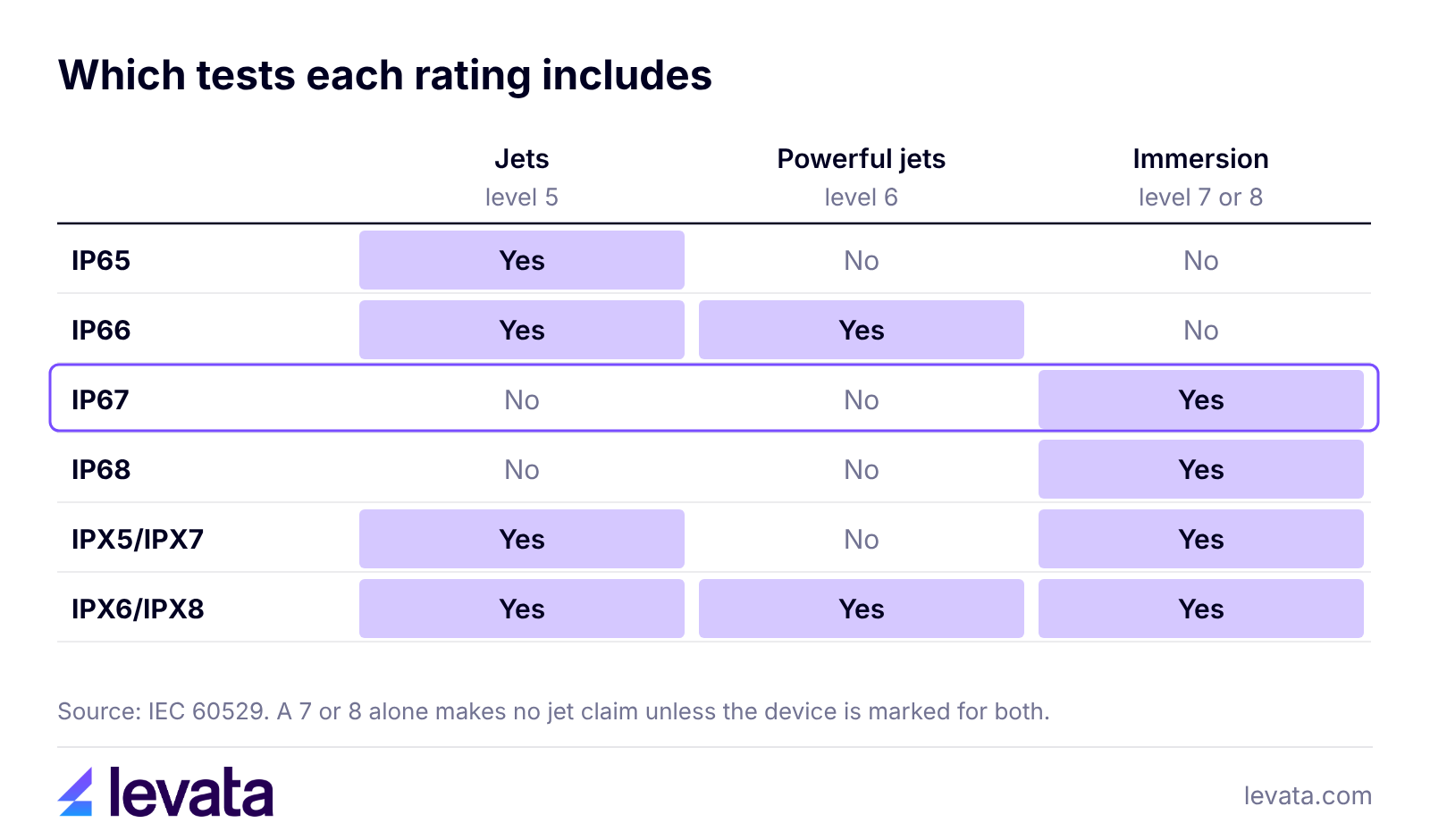
A higher IP rating does not always mean better protection, because the water levels above 6 test different things from the jet levels. Under IEC 60529, a level up to 6 includes all the lower levels, so IP66 also meets IP65. Levels 7 and 8 do not work that way. A device marked with only a 7 or an 8 is considered unsuitable for water jets unless it is marked for both.
Makers show both by marking two codes. IPX5/IPX7 means the device passed the jet test and the immersion test. IPX6/IPX8 means it passed the powerful jet test and a continuous immersion test. A plain IP68 on a spec sheet is an immersion claim, so check whether the maker also lists IP65 or IP66.
IP69K stands apart from this ladder. It comes from the road vehicle standard ISO 20653, and its test uses 80 °C water at 80 to 100 bar from 100 to 150 mm.
IEC 60529 added a close relative, IPX9, in 2013 with a nearly identical procedure. Choose IP69 or IP69K for hot washdowns. An IP68 device can still fail that test.
An IP rating does not cover impacts such as drops, corrosion, sunlight, ice, condensation or corrosive solvents, because IEC 60529 leaves those to other standards. The water tests use fresh water, and the standard warns that real protection may fall short when cleaning uses solvents or hot, high-pressure jets beyond the level 9 test.
That matters in healthcare, where staff wipe tablets with disinfectants across shifts. The wipes are a chemical stress the IP test never measured, so check the maker's cleaning guide. Levata's rugged healthcare tablets are the place to start.
The rating is also a type test on new, clean samples with every part in place. Port covers and battery doors must be closed and seated for the rating to apply, and seals can wear over years of use. Lenovo notes that an IP rating can drop over time as protection degrades.
Drop and vibration ratings are separate. TechRadar makes the point that an IP rating alone does not make a device rugged, so read the shock and temperature specs next to it.
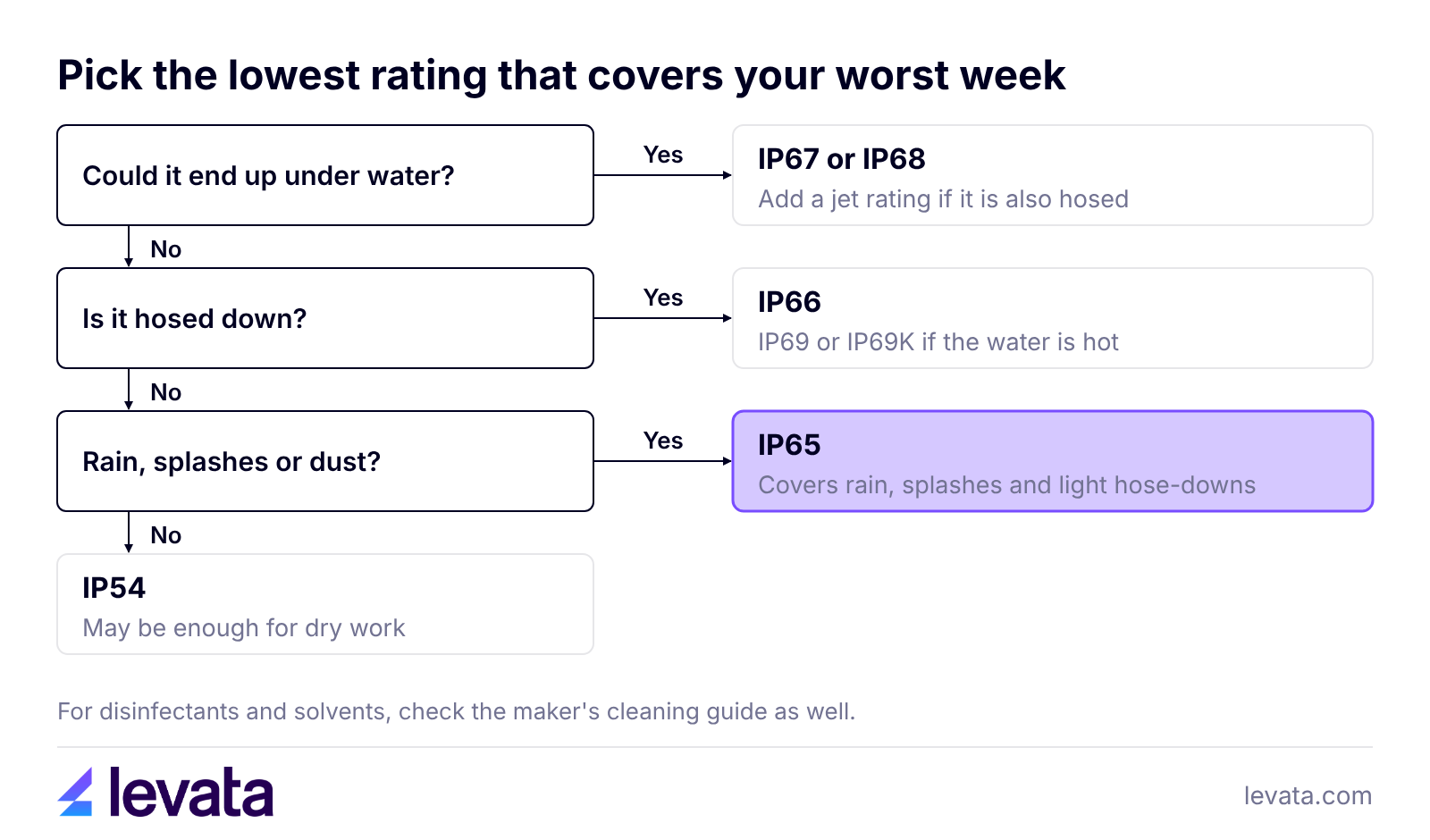
A rugged tablet or laptop needs IP65 for dust, rain and splashes, IP66 for powerful hose-downs, and IP67 or IP68 when it could end up under water. Pick the lowest rating that covers the worst week the device will have, then check the second digit against the chart above.
| Where the device works | Rating to look for | Why |
|---|---|---|
| Dry warehouse or retail floor | IP54 or IP65 | Dust and splashes covered, no hose or flood expected |
| Dusty dock, yard or vehicle cab | IP65 | Dust-tight, with rain and splashes covered |
| Outdoor field service in rain | IP65 or IP66 | Water jets from any direction |
| Washdown area | IP66, or IP69K for hot water | Powerful jets, and hot jets at close range |
| Construction, marine or flood-prone site | IP67 or IP68, plus IP65 or IP66 if hosed | Immersion, with jet protection only if listed |
| Healthcare with disinfectant wipes | IP65, plus the maker's cleaning guide | Chemicals sit outside the IP test |
Levata's mobile computers category shows how ratings are spread across its full portfolio of mobile computers. Devices range from IP52 rating, IP54, IP65, IP66, IP67, IP68, and IP69.
Do not buy more rating than the worst week needs. If the device lives in a dry building, IP54 or IP65 covers the job. Step up when the second digit matches something that really happens to the device, such as a hose, a flood or a dunk.
To compare models by rating, use the IP rating filter in the mobile computers category, or start with the Honeywell EDA10A tablet at IP65.
An IP rating measures protection against dust and water, while an IK rating measures resistance to mechanical impact. Delvalle describes IK as a separate scale from IK00 to IK10 under EN 62262. A rugged device can list both, and neither says anything about the other.
NEMA ratings come from the NEMA 250 enclosure standard used in North America, which also covers factors IP leave out, such as corrosion resistance, and conversions between the two are approximate. FIRGELLI lists NEMA 4 as roughly IP66 and NEMA 6 as roughly IP67. Treat those pairs as a starting point and check the maker's own claim.
Check the datasheet or product brochure first, because the rating is listed under technical specifications. Some models also print it on the chassis or near the battery, as Panasonic notes for its Toughbook line. If neither shows a rating, treat the device as unrated.
No single rating defines rugged. Wikipedia notes that levels of ruggedization are not standardized, and sources draw the line in different places. Conker, a rugged device maker, says IP54 is the minimum for fully rugged technology. Read the IP rating together with the shock, vibration and temperature specs.
The rating that matters is the one that matches the worst week the device will have. Read both digits, check whether a 7 or an 8 comes with a jet rating, and ask for the depth and time behind any IP68 claim.
Levata's team can match a rating to your site and show which rugged tablets and rugged laptops carry it. Tell us where the work happens, and what devices are exposed to, and we will recommend the best fit-for-purpose solutions.
Find the best rugged laptop for your work environment. Compare fully rugged, semi-rugged and ruggedized models by rating, display, battery and price.

Rising costs, competition, and customer expectations keep squeezing retail margins. Learn how inventory visibility, workforce optimization, supply chain insights, and data-driven decisions help retailers protect profitability for the long term.

This guide explains the most crucial decision factors when selecting a rugged tablet - from IP ratings to operating systems.
Welcome, ID Card Group customers!
On September 24th, IDCardGroup.com transitioned to Levata.com. You still have access to the ID solutions you rely on, along with a broader selection of data capture and technology solutions.
What you can expect:
Questions? Call 1-833-353-8282.
Thank you for choosing Levata.
Welcome, IT Planet customers!
On September 24th, ITPlanet.com transitioned to Levata.com. You still have access to the products you rely on, along with a broader selection of data capture and technology solutions.
What you can expect:
Questions? Call 1-833-353-8282.
Thank you for choosing Levata.
Welcome, Barcode Planet customers!
On September 24th, BarcodePlanet.com transitioned to Levata.com. You still have access to the products you rely on, along with a broader selection of data capture and technology solutions.
What you can expect:
Questions? Call 1-833-353-8282.
Thank you for choosing Levata.