Select model

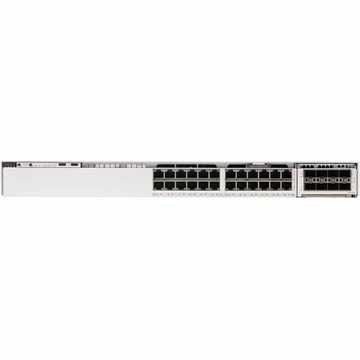
The Cisco Catalyst C9350 Series is a rack-mountable, Layer 3 stackable Ethernet switch built for managed enterprise and campus access-layer deployments, combining Power over Ethernet, advanced security, and flexible application hosting in a 1U chassis.
Key Features:
- 24 x 10/100/1000BASE-T Gigabit Ethernet PoE+ RJ-45 ports deliver a 720 W PoE budget across the access layer, supporting powered devices at scale under IEEE 802.3bt.
- Layer 3 support enables on-switch IP routing, reducing the need to hairpin traffic to a separate router and keeping latency predictable across segments.
- Stack port connectivity and high-availability design allow multiple switches to operate as a unified logical unit, with In-Service Software Upgrade (ISSU) keeping the stack available during software maintenance.
- Hardware-level Access Control Lists (ACL) and Virtual Extensible LAN (VXLAN)-based campus fabric segmentation enforce zero-trust policies at line rate without offloading to software.
- Line-rate MACsec AES-GCM-256 encryption and hardware-capable IPsec protect data in motion across the switching fabric, while post-quantum cryptography (PQC) algorithm support guards against future cryptographic threats.
- X86-based multicore CPUs paired with DDR5 memory and local SSD storage host third-party Docker container applications, including ThousandEyes and Cisco Spaces, directly on the switch.
- Redundant power supply support accommodates up to 3 power supplies with AC and DC input voltage options, reducing the risk of a single power event taking down the switch.
- A measured MTBF of 342720 hours reflects the reliability expected of always-on access-layer infrastructure.
A Stackable Access-Layer Platform with Unified Management
The C9350 Series sits within Cisco's Catalyst portfolio as the access-layer stackable switch designed to bridge the enterprise edge to the network core. Its unified hardware architecture supports cloud, on-premises, and hybrid management models from a single hardware platform, and its unified licensing model carries advanced features and capabilities consistently across the range.
Port Density and Physical Connectivity
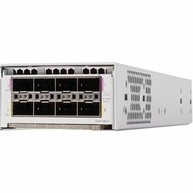
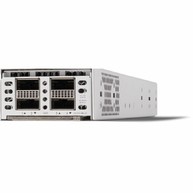
The switch provides 24 x 10/100/1000BASE-T Gigabit Ethernet PoE+ RJ-45 network ports, a dedicated 10/100/1000Base-T RJ-45 management port, an RJ-45 console port, and a USB 3.0 port. Uplink ports extend connectivity beyond the access layer, and the stack port integrates multiple units into a single logical switch. Twisted pair cabling is supported across all RJ-45 interfaces.
Power over Ethernet Keeps Devices Running
With a 720 W PoE budget and conformance to IEEE 802.3bt, the switch can simultaneously power a dense population of endpoint devices from its 24 PoE+ ports. Fast PoE and Perpetual PoE capabilities, as referenced in the platform marketing data, allow powered devices to receive power during switch boot sequences, reducing downtime windows for connected endpoints. Redundant power supply support — accommodating up to 3 power supplies, with 1 installed as standard — means power architecture can be scaled to match availability requirements.
Flexible Power Input for Varied Deployment Environments
Input voltage options span 120 V AC, 230 V AC, -36 V DC, and -72 V DC, giving installation teams the flexibility to connect the switch to both standard AC mains and DC power plant infrastructure without requiring external conversion equipment.
Layer 3 Switching and Network Segmentation
Operating at Layer 3, the C9350 performs IP routing functions that would otherwise require a separate routing device at the distribution layer. Campus fabric-based segmentation using VXLAN and Cisco TrustSec enables administrators to isolate traffic between groups of users or devices without relying purely on physical topology, making policy changes a software operation rather than a recabling exercise.
Security Enforcement at Hardware Speed
High-scale hardware Access Control Lists (ACL) enforce traffic policy at line rate, ensuring that security filtering does not become a throughput bottleneck. MACsec AES-GCM-256 encryption operates at line rate across the switching fabric, and hardware-capable IPsec supports encrypted tunneling at up to 100G. Post-quantum cryptography (PQC) algorithm support prepares the switch for environments where long-term data confidentiality must be defended against quantum-enabled decryption. The platform is also Cisco Hypershield-ready for advanced threat mitigation and hardware-ready for day-zero attack mitigation through Cisco Live Protect.
Traffic Visibility and Application Awareness
High-scale hardware Flexible NetFlow (FNF) and Application Visibility and Control (AVC) with Network-Based Application Recognition (NBAR) give network teams granular insight into which applications are consuming bandwidth and from which endpoints. SPAN and RSPAN packet mirroring feeds traffic copies to analysis tools without disrupting production flows, while IPDT and SISF device tracking maintain a continuously updated inventory of connected endpoints.
On-Switch Application Hosting
Enhanced X86-based multicore CPUs and DDR5 memory, combined with local solid-state drive storage and two 10G app gig ports, allow the switch to run third-party Docker container-based applications natively. Supported applications include ThousandEyes for network intelligence and Cisco Spaces for location services, removing the need to deploy separate compute hardware for these functions.
Stacking and High Availability
Stack port connectivity supports a 1.6 Tbps stacking architecture, allowing multiple C9350 units to present as a single managed switch to the rest of the network. High availability is supported at the platform level, and In-Service Software Upgrade (ISSU) allows software to be updated across the stack without taking the network offline — a meaningful consideration for access-layer switches that are rarely given scheduled maintenance windows.
Simplified Day-One Deployment
Plug and Play support means the switch can be brought into service without requiring an engineer to be physically present at the device for initial configuration, reducing the time and cost of deploying new sites or expanding existing ones.
Physical Format and Reliability
The switch occupies 1.7" of rack height in a 17.5" wide, 16.5" deep chassis that weighs approximately 13.54 lb, fitting a standard 1U rack space. The measured MTBF of 342720 hours provides a quantified basis for reliability planning in access-layer designs where switch uptime directly affects end-user connectivity.
Markets and Applications
Network, Security, Enterprise, Campus, Camera, Traffic, IP Phone, Surveillance, Wireless Access Point
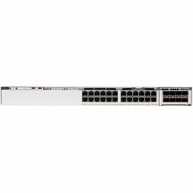
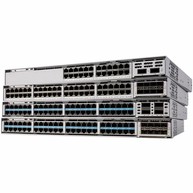
Cisco C9350 48-Port PoE Ethernet Switch - C9350-48U
C9350-48U
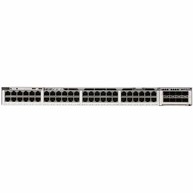
Cisco C9350 48-Port PoE Managed Ethernet Switch - C9350-48HX
C9350-48HX
Cisco Catalyst C9350 24-Port Managed Ethernet Switch - C9350-24T
C9350-24T