
Select model

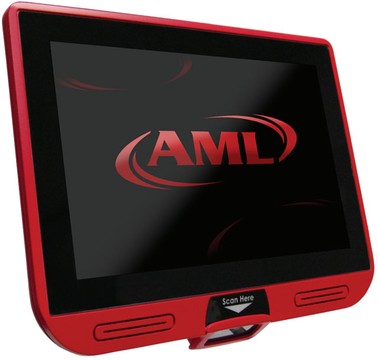
The AML Monarch+ is a purpose-built interactive self-service kiosk that merges desktop computing capability with a tablet-style touch experience. Designed for retail, hospitality, and commercial applications, it combines an Intel Atom E3815 1.46GHz processor, a 10.1-inch color touchscreen display, and an integrated 2D barcode imager within a compact, low-power enclosure that draws less than 13 watts and ships ready for Power-over-Ethernet deployment.
Key Features:
- The Intel Atom E3815 1.46GHz Single Core processor, with an optional Dual Core configuration available, provides the compute headroom needed to run modern touch-friendly Windows applications at a self-service kiosk.
- A 10.1-inch IPS LCD panel at 1280 x 800 resolution delivers consistent color and wide viewing angles, keeping on-screen content legible from the angles typical of a standing customer interaction.
- The Projective Capacitive Multi-touch display supports gesturing and swiping, allowing developers to build Windows 8 Modern-style apps alongside traditional Windows applications without additional hardware.
- An integrated 2D Imager handles barcode scanning directly within the unit, removing the need for a separate scanner peripheral at the kiosk station.
- Power draw of less than 13 watts combined with PoE (802.3af and 802.3at) readiness means the kiosk can be positioned anywhere an Ethernet cable reaches, without requiring a dedicated electrical outlet or licensed electrical work.
- Optional 802.11 BGN 2x2 wireless with Bluetooth 4.0 Smart Ready extends connectivity choices for deployments where a wired Ethernet run is not practical.
- Windows Embedded 8.1 Industry Pro provides enterprise-grade security features including Secure Boot, Trusted Boot, and BitLocker, alongside advanced lockdown filters for USB, gesture, keyboard, and notifications.
- Internal storage is available as a 32GB mSATA SSD and 4GB eMMC 4.5, expandable via a Micro SDHC slot capable of accepting cards up to 64GB.
The Monarch+ occupies AML's self-service kiosk line as a built-for-purpose unit rather than a repurposed general-purpose display, with its physical design, power architecture, and software platform selected specifically for attended and unattended customer-facing deployments in retail, hospitality, and commercial environments.
Processor and Computing Platform
At the core of the Monarch+ is an Intel Atom E3815 running at 1.46GHz in a Single Core configuration, with a Dual Core option available. The platform runs Windows Embedded 8.1 Industry Pro, which means application developers can target both traditional Win32 applications and Windows 8 Modern-style touch applications from a single device without maintaining separate hardware environments.
Memory and Storage Keep Data Close
The unit ships with 2GB DDR3L RAM running at 1333 MT/s. Internal storage combines a 32GB mSATA SSD with a 4GB eMMC 4.5 module, and the Micro SDHC slot accepts cards up to 64GB when local storage needs to expand for additional content or logging.
Display and Touch Input
The 10.1-inch IPS LCD screen resolves at 1280 x 800, and its Projective Capacitive Multi-touch layer registers the finger gestures — pinch, swipe, tap — that customers expect from a modern touch interface. IPS panel technology holds color accuracy across the wider viewing angles that characterize a kiosk rather than a desk monitor, where the viewer's angle can vary considerably.
Integrated 2D Barcode Scanning
A 2D Imager is built into the unit, enabling it to read both linear and two-dimensional barcodes without an attached peripheral. This matters for price-check and product-lookup workflows where a customer is expected to scan merchandise themselves at the kiosk station.
Power Architecture and PoE Readiness
The Monarch+ operates on 5VDC and supports PoE via 802.3af and 802.3at standards, drawing its power directly from the Ethernet cable connected to a compatible switch or power injector. Because Ethernet cabling is classified as low-voltage, it does not require installation by a licensed electrician or enclosure in metal conduit, and there is no requirement for an outlet box at the mounting location. The total power consumption stays below 13 watts, which matters in multi-unit retail deployments where power load across a store floor adds up.
Wired and Wireless Connectivity
A standard RJ45 Gigabit Ethernet port handles wired network connection and carries the PoE power simultaneously. For locations where pulling a data cable to the exact mounting point is not feasible, an optional 802.11 BGN 2x2 radio with Bluetooth 4.0 Smart Ready provides wireless connectivity. Additional expansion is available through a Mini PCI Express slot.
I/O Ports and Audio
Beyond the network connection, the unit exposes two USB 2.0 ports for peripherals and an HDMI output for driving an external display. A stereo speaker rated at 3W per channel is built in, supporting audio playback for applications that use sound as part of the customer interaction.
Physical Dimensions and Mounting
The enclosure measures 267mm wide by 211mm high by 47mm deep and weighs 2.15 lbs (0.98 kg). A standard VESA 75mm mount pattern is built in, and a power adapter mounting bracket is included, so the unit can be attached to walls, poles, or display arms without proprietary hardware.
Environmental Operating Range
The Monarch+ operates within a temperature range of 0 to 40 degrees C (32 to 104 degrees F) and tolerates storage temperatures from -20 to 60 degrees C (-4 to 140 degrees F). Humidity tolerance runs from 5% to 90% non-condensing, covering the range of conditions found in temperature-controlled commercial interiors.
Enterprise Security and Lockdown via Windows Embedded
Windows Embedded 8.1 Industry Pro brings a set of features specifically relevant to unattended or semi-attended kiosk operation. Secure Boot and Trusted Boot protect the startup sequence, while BitLocker provides drive encryption. The Advanced Lockdown filters — covering USB, Gesture, Keyboard, Dialog, Notification, and Unified Write — allow IT administrators to restrict what a customer can interact with on the device, keeping the kiosk confined to its intended application without requiring custom firmware.


AVERY DENNISON, 2.0" X 1968' TUFFMARK RESIN RIBBON FOR 98XX, ADTP1 AND ADTP2 PRINTERS
11898120A
AVERY DENNISON, 3.0" X 1968' TUFFMARK RESIN RIBBON FOR 98XX, ADTP1 AND ADTP2 PRINTERS
11898130A

AVERY DENNISON, HIGH SPEED TAG CUTTER FOR ADTP1EF PRINTERS
M00933
AVERY DENNISON, TAG STACKER FOR ADTP1EF PRINTERS
M0092802